Technology marketing services are specialized strategies designed to promote complex software, hardware, and SaaS products to technical buyers. Unlike general marketing, these services focus on navigating long sales cycles, providing deep product education, and translating technical specifications into tangible business value for decision-makers.
If you are a CTO or founder struggling to convert technical prospects, you aren’t alone. With AI-driven buying behaviors and self-educating buyers dominating the market, generic tactics no longer work. This guide breaks down the specific technology marketing services required to build trust, generate qualified leads, and drive revenue in the US tech sector.
Quick Summary
- Differentiation: Tech marketing requires translating code into business value for skeptical buyers.
- Foundation: Success starts with data-driven personas and clear KPIs (ARR, LTV).
- Core Services: Content, SEO, and Email are essential for educating long-cycle leads.
- Growth: Advanced tactics like ABM and Product Marketing align sales and marketing.
- Future: AI and privacy-first data strategies are the new standard for 2026.
Navigating the Unique World of Technology Marketing
What is Technology Marketing and Why is it Different?
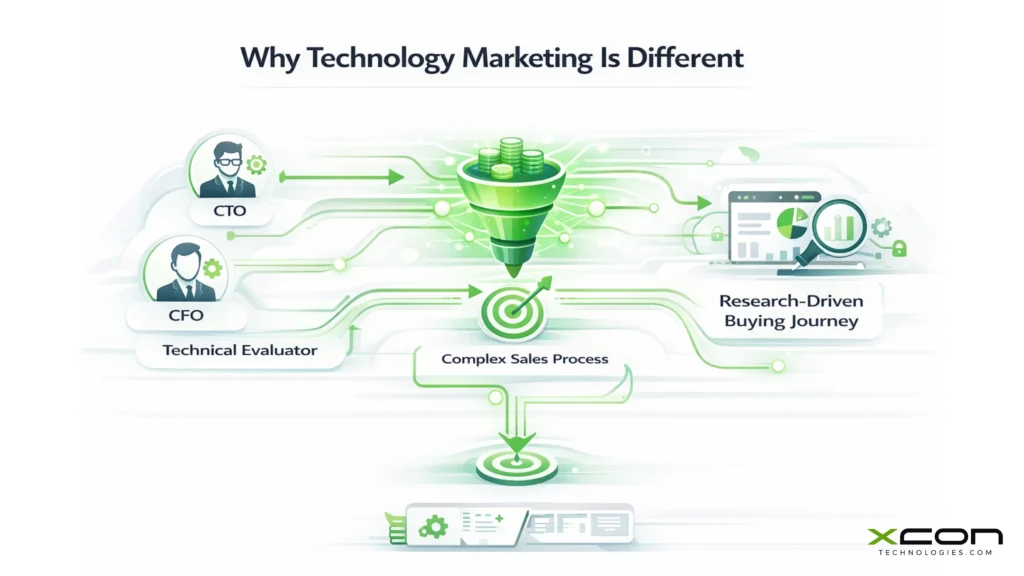
Technology marketing is the strategic promotion of technology products where the value must be proven technically and financially before purchase. It differs fundamentally from B2C because it targets multiple stakeholders, users, technical evaluators, and economic buyerswho demand technical depth rather than emotional hooks.
The Critical Role of Marketing for Tech Companies
Strategic marketing acts as the bridge between innovation and adoption. For SaaS and B2B tech companies, effective marketing drives user acquisition, reduces churn, and differentiates your solution in a crowded market. Without it, even superior code fails to generate revenue.
Laying the Strategic Foundation: Before You Launch a Campaign
Defining Your Vision
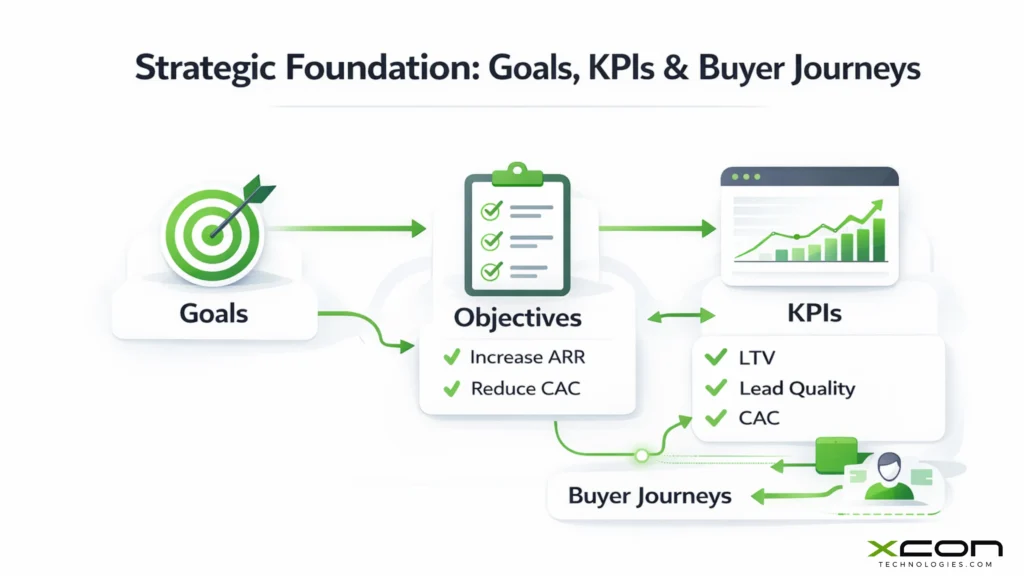
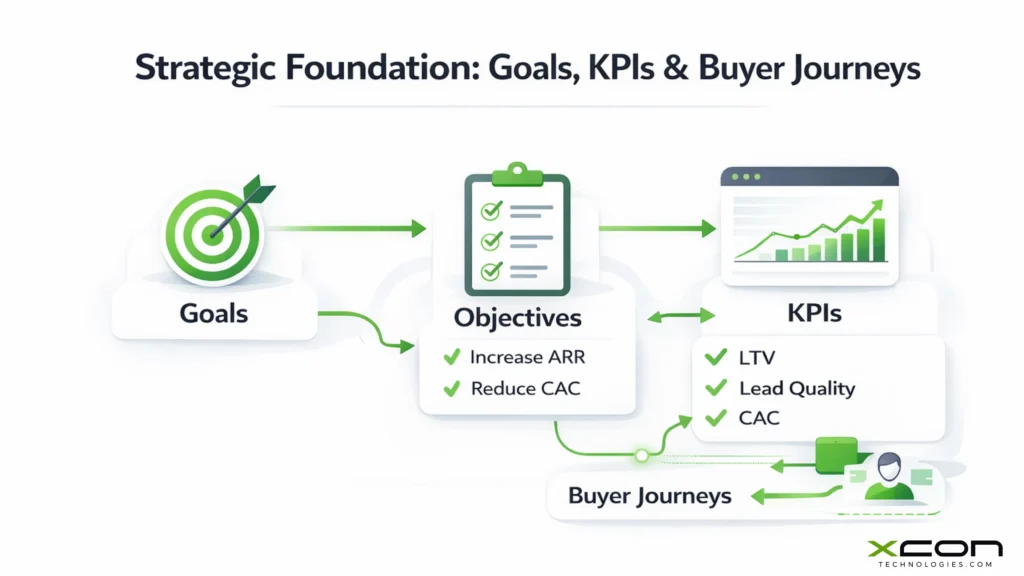
Success starts with distinguishing your destination from your metrics. Your goal might be market leadership, your objective is to increase qualified leads by 20%, and your KPIs (Key Performance Indicators) are the metrics like ARR (Annual Recurring Revenue) and CAC (Customer Acquisition Cost) that track your progress.
Understanding Your Audience
You must map the journey for distinct personas, such as the technical evaluator (CTO) and the budget holder (CFO). The journey moves from Awareness (realizing a problem exists) to Consideration (comparing feature sets) to Decision (negotiating contracts), requiring different content at every stage.
Deep Dive into Market Research and Competitive Analysis
Stop guessing and start analyzing. Effective research examines competitor messaging, pricing models, and feature gaps. Use data-driven insights to identify exactly where your solution outperforms legacy systems or competitors.
Crafting a Compelling Value Proposition and Storytelling
Your architecture is complex, but your story must be simple. Connect your value proposition directly to solving a specific user pain point. Great storytelling makes your technical solution the obvious, inevitable choice for the buyer’s problem.
Core Technology Marketing Services & Strategies
Content Marketing
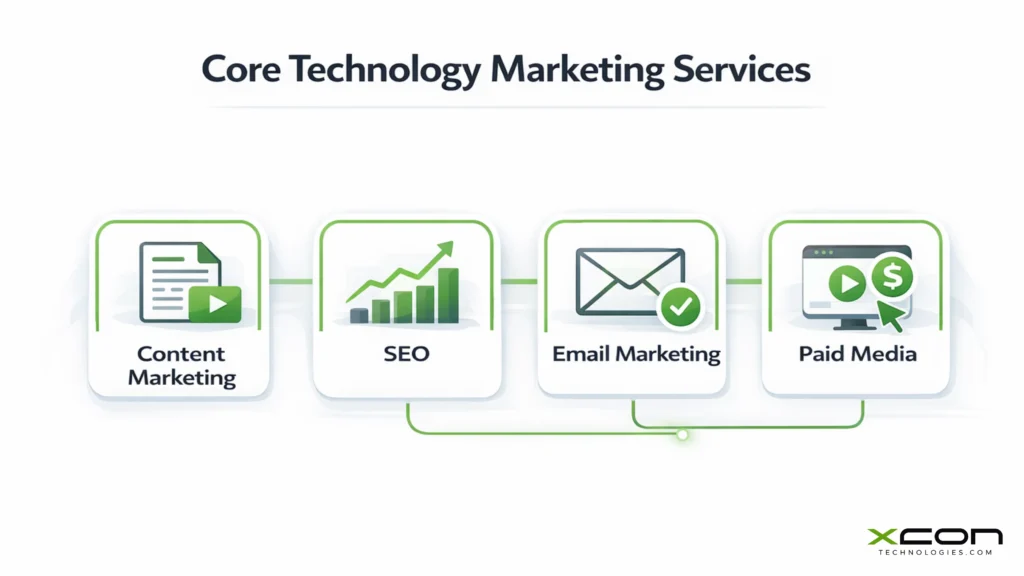
Content is the fuel for tech sales cycles.
- Whitepapers: Deep dives for technical vetting.
- Blogs: SEO-driven answers to specific coding or integration questions.
- Case Studies: Proof of concept for economic buyers.
Search Engine Optimization (SEO)
SEO for tech goes beyond basic keywords; it requires topical authority. You must optimize for high-intent queries and technical comparisons to capture buyers during their research phase. Focus on entities and semantic depth to satisfy modern search engines.
Social Media Marketing
Engagement matters more than virality. Focus on platforms where developers and decision-makers congregate, such as LinkedIn for business credibility, or Reddit and GitHub for authentic technical community building.
Email Marketing
Nurture leads through extended buying cycles. Use automated, logic-based drip campaigns to educate prospects on specific features, keeping your brand top-of-mind until budget becomes available.
Paid Online Advertising
Paid media is your accelerator for market validation. Focus on intent-driven ads on LinkedIn and retargeting campaigns to bring high-value visitors back to your pricing or demo pages.
Advanced & Specialized Strategies for Tech Companies
Account-Based Marketing (ABM)
ABM treats individual enterprise accounts as markets of one. It aligns sales and marketing teams to target high-value “whales” with hyper-personalized messaging, rather than casting a wide net for smaller leads.
Product Marketing
Product marketing ensures your innovation is positioned correctly. It translates new features into customer benefits, manages go-to-market (GTM) launches, and arms sales teams with the battle cards needed to win competitive deals.
B2G Marketing
Selling to the government requires navigating complex procurement vehicles and strict compliance standards. B2G marketing focuses on building long-term trust and demonstrating stability to federal agencies and public sector organizations.
Influencer Marketing
Partner with niche experts to borrow authority. A mention from a respected industry analyst, tech YouTuber, or recognized developer can build instant credibility with skeptical technical audiences.
Customer Experience and Advocacy Marketing
Retention is the most efficient growth lever. Turn satisfied users into advocates through structured review campaigns on G2 or Capterra, and leverage positive customer experiences to drive referrals.
Building Your MarTech Stack for Efficiency and Impact
Understanding the MarTech Ecosystem
MarTech is the infrastructure that powers your strategy. It is the collection of integrated software used to plan, execute, and measure marketing campaigns, ensuring scalability as your user base grows.
Key Components of a Tech Company’s MarTech Stack
- CRM: Salesforce or HubSpot for data truth.
- Automation: Marketo or ActiveCampaign for workflows.
- Analytics: GA4 or Mixpanel for user behavior.
- CMS: WordPress or Webflow for content management.
Leveraging Automation and AI in Marketing
AI is an efficiency multiplier, not just a buzzword. Use it to personalize email outreach at scale, predict churn risks, and automate routine data entry tasks to free up your team for strategy.
Integration and Data Flow: Connecting Your Tools
Siloed tools destroy decision-making capabilities. Ensure your data flows seamlessly between your CRM, automation tools, and analytics platforms to create a single, unified source of truth.
Data, Measurement, and Optimization: Driving Smarter Decisions
Establishing Robust Data Tracking and Analytics
Track outcomes, not just activity. Focus on conversion rates, pipeline velocity, and lead quality rather than vanity metrics like social likes or raw page views.
Actionable Insights from Your Marketing Data
Data should strictly drive action. If a specific channel shows a high Customer Acquisition Cost (CAC) but low Lifetime Value (LTV), pivot your budget elsewhere immediately.
Attribution Modeling: Understanding ROI Across the Customer Journey
Tech buying is multi-touch. Use attribution models to visualize which whitepaper, webinar, or ad actually contributed to revenue, giving credit where it is due across the funnel.
A/B Testing and Continuous Optimization
Adopt a culture of experimentation. Constantly A/B test your landing page headlines, email subject lines, and ad creatives to incrementally improve conversion rates.
Navigating Data Privacy and Ethical Marketing
Trust is your most valuable currency. Adhere strictly to GDPR, CCPA, and other regulations to protect user data. Transparent data practices are now a competitive advantage.
Building and Managing Your Tech Marketing Team or Agency Partnerships
In-House vs. Agency: Weighing Your Options
In-house teams offer deep product knowledge and cultural alignment, while agencies provide specialized skills (like SEO or paid media) and scalability without the operational overhead.
Key Roles and Skills for a Tech Marketing Team
- Product Marketer: The translator of tech to value.
- Content Strategist: The voice of authority.
- Demand Gen Specialist: The funnel builder.
- Marketing Ops: The data architect.
Effective Collaboration with Sales and Product Teams
Revenue teams must be aligned. Regular syncs between sales and marketing ensure that lead definitions match and that feedback from the front lines informs product messaging.
Selecting and Managing a Technology Marketing Services Provider
Look for proven sector experience. Choose a partner who challenges your assumptions, offers total transparency on performance, and understands your specific technical vertical.
Future Trends Shaping Technology Marketing
The Continued Rise of AI and Generative AI in Marketing
Generative AI will become standard for content drafts and personalization. It will assist in analyzing vast datasets to predict buyer intent with unprecedented accuracy.
Enhanced Personalization and Omnichannel Experiences
Buyers expect B2C-level experiences in B2B. Marketing must deliver hyper-relevant content across web, mobile, and email seamlessly, recognizing the user wherever they are.
Web3, Metaverse, and Emerging Digital Frontiers
Immersive digital spaces offer new demo potential. While early, these frontiers offer unique ways to demonstrate complex hardware and software in virtual environments.
The Evolving Privacy Landscape
Privacy is paramount. Prepare for a cookie-less future by building robust first-party data strategies now, relying less on third-party tracking.
Conclusion:
- Prioritize strategy and data over random tactics.
- Align sales and marketing for a unified revenue engine.
- Invest in content that genuinely educates technical buyers.
Pro Tips / Safety Advice
- Don’t Ignore Mobile: Even B2B buyers research phones.
- Verify Data: Double-check analytics setup to avoid garbage-in, garbage-out.
- Consistency: Keep messaging uniform across all channels.
Final Thoughts / Encouragement
Tech marketing is a marathon, not a sprint. By building a solid foundation of data, content, and strategy today, you position your company for sustainable growth in the years ahead.
FAQ
Technology marketing services are specialized agency or in-house functions designed to promote tech products. They include content marketing, SEO, ABM, and lead generation tailored for technical buyers.
Most B2B tech companies spend between 8% and 15% of their revenue on marketing. High-growth startups often invest up to 20% or more to capture market share aggressively.
It depends on your stage. Early-stage startups often benefit from agencies for flexibility and broad skills. Mature companies usually build in-house teams for core functions and use agencies for specialized support.
Content marketing (SEO), email nurturing, and LinkedIn advertising are typically the highest-performing channels for SaaS due to their ability to target and educate specific professional personas.
ROI is measured by tracking Customer Acquisition Cost (CAC) against Customer Lifetime Value (LTV). Attribution modeling helps identify which specific campaigns generated the revenue.