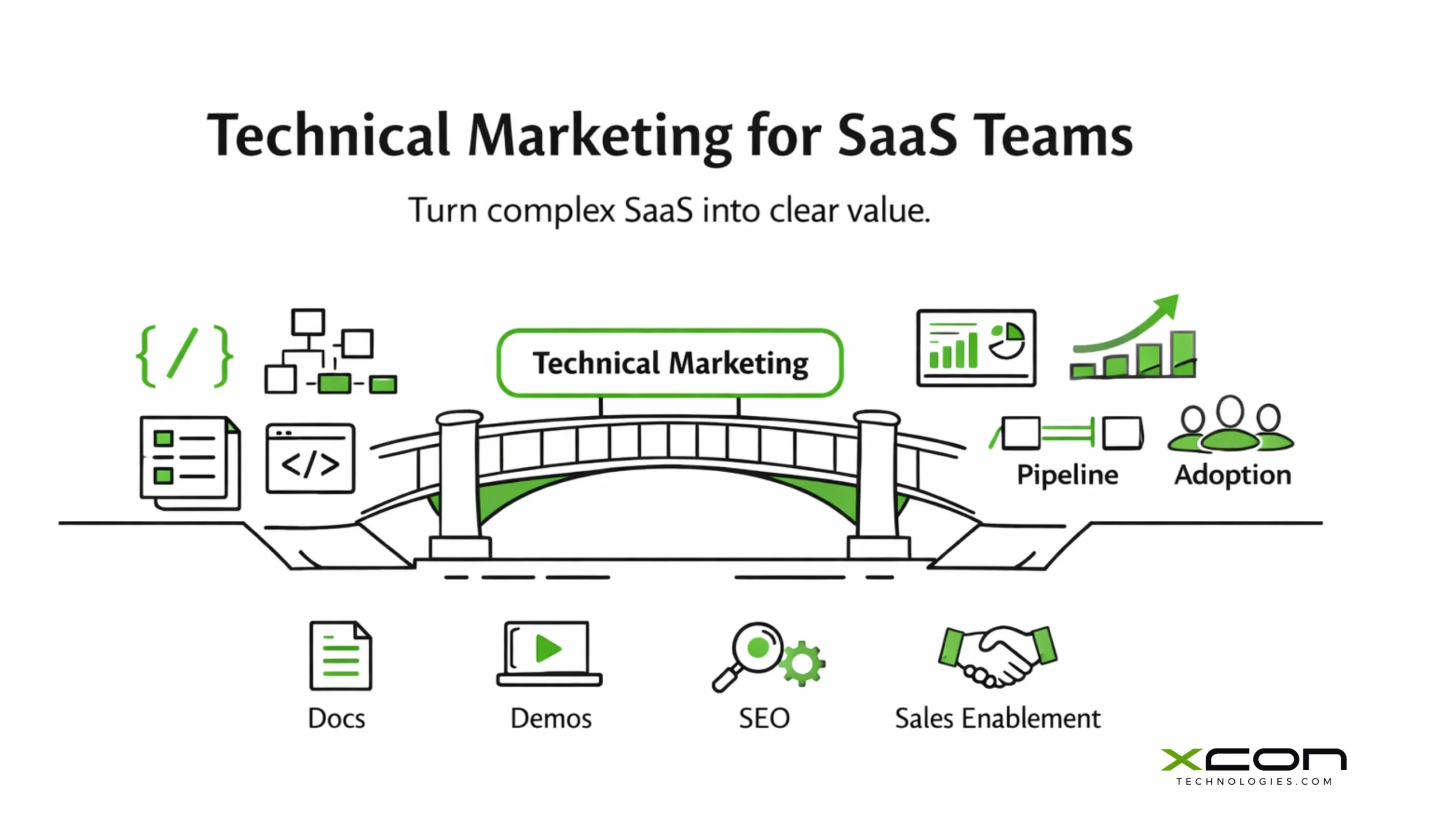
Technical marketing explains how technical products work. It targets technical audiences to boost adoption and revenue. It mixes technical skills with content creation, like docs, demos, and diagrams, and also includes digital marketing, such as SEO and campaigns. This helps buyers test, trust, and install a solution with assurance.
What It Is and How It Works
If you sell SaaS products in the technology industry, especially in the AI space, you’ve seen the gap:
- Your product is powerful, but hard to explain.
- Buyers are technical decision-makers. These include solutions architects, sales engineers, systems administrators, and Data Privacy Consultants.
- The “wow” lives in workflows, API endpoints, architecture, and proof, not slogans.
That’s where Technical Marketing earns its keep. It translates complex tech products into clear, credible stories. These stories come with assets that buyers can test, share, and trust.
Why Technical Marketing Matters: Bridging the Tech-Business Divide
Communicating Complex Technology to Diverse Audiences
SaaS teams rarely sell to “one persona.” A single deal can involve:
- A product manager evaluating roadmap fit
- A solutions architect validating security and architecture diagrams
- A support engineer asking about failure modes
- A buyer asking for ROI proof and implementation risk
When messaging stays high-level, technical buyers stall. When messaging goes too deep without structure, non-technical stakeholders tune out. Technical marketing bridges both.
If you’re selling an AI workflow platform, your buyer needs more than “automation.” They want:
- data flow + permissions
- model behavior boundaries
- deployment options
- monitoring + governance
- integration details (API endpoints, webhooks)
The Essential Role of Technical Marketing as a Translator and Evangelist
A strong technical marketer acts like:
- Translator: turns internal planning notes into crisp customer language
- Evangelist: helps the market understand why your approach matters
- Educator: makes evaluation easy with demos, labs, and interactive course modules
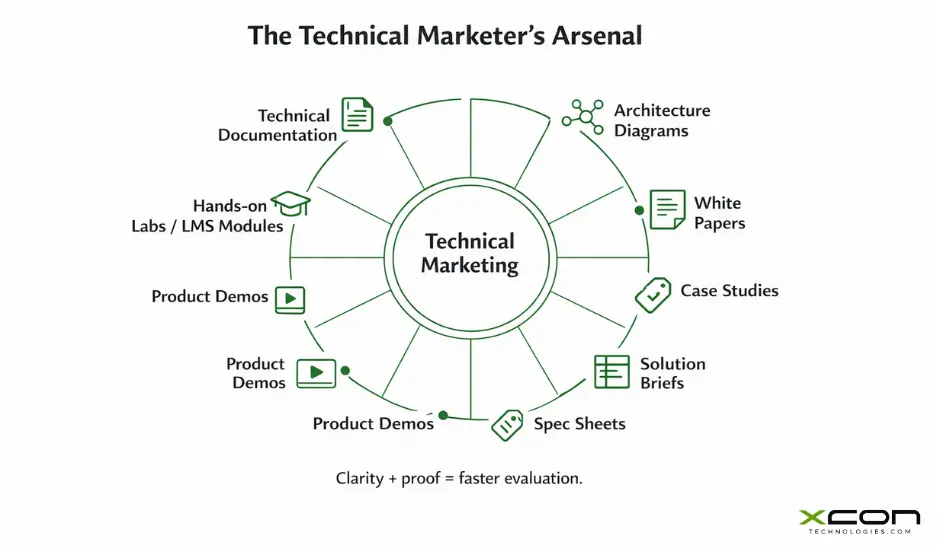
- Proof-builder: creates assets that reduce risk: case studies, solution briefs, spec sheets
This role sits between product marketing and technical teams. It collaborates with a product marketing manager, product marketer, and product management team.
The Business Imperative
For technical products, evidence builds trust. Great Tech Marketing improves:
- adoption (people actually use the features they bought)
- sales velocity (fewer “prove it again” cycles)
- retention (less confusion, fewer support tickets)
- Teams share successful strategies internally.
Defining Technical Marketing: More Than Specs
What exactly is Technical Marketing?
Technical marketing focuses on making complex products understandable and verifiable. It’s not describing features, it’s demonstrating outcomes with technical depth.
Typical outputs include:
- technical content and technical documentation
- architecture diagrams and spec sheets
- white papers, solution briefs, and security explainers
- product demos and product demonstrations
- technical hands-on labs and interactive course modules (often inside a learning management system)
- Industry event presentations. Sometimes for the “swag folks” and booth dwellers, too.
Technical Marketing vs. Product Marketing: A Clear Distinction in Focus and Execution
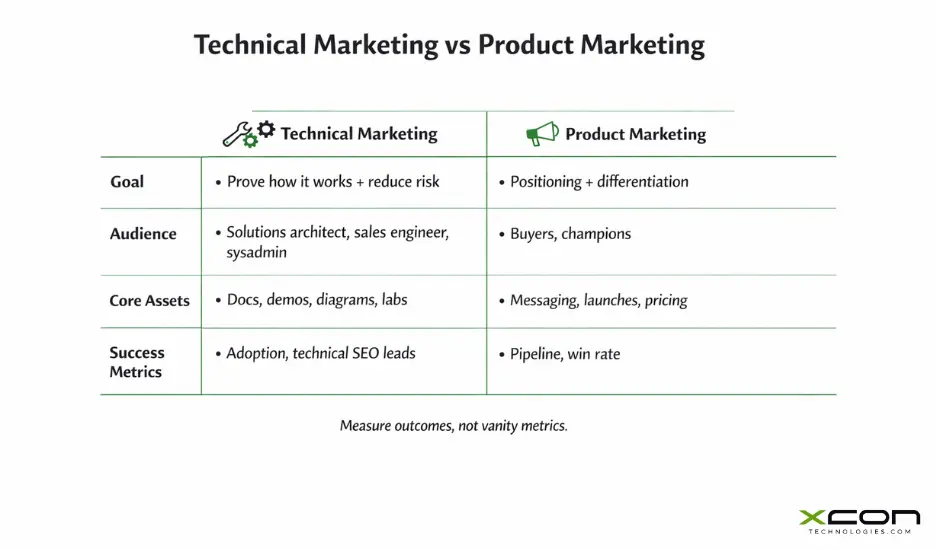
Both matter. Their center of gravity is different.
| Area | Technical Marketing | Product Marketing |
| Primary goal | Prove how it works + reduce risk | Positioning + differentiation + narrative |
| Audience | software developers, solutions architect, sales engineer, sysadmin | buyers, champions, economic decision-makers |
| Core assets | docs, labs, diagrams, demos, spec sheets | messaging, launches, pricing pages, market analysis |
| Success signals | adoption, implementation speed, technical SEO leads | pipeline, conversion rate, win rate |
In many SaaS teams, roles can blur. The company expects the product marketing manager to handle everything when this happens. That’s why a dedicated technical marketing manager can be a force multiplier.
Core Objectives of Technical Marketing: From Awareness to Advocacy
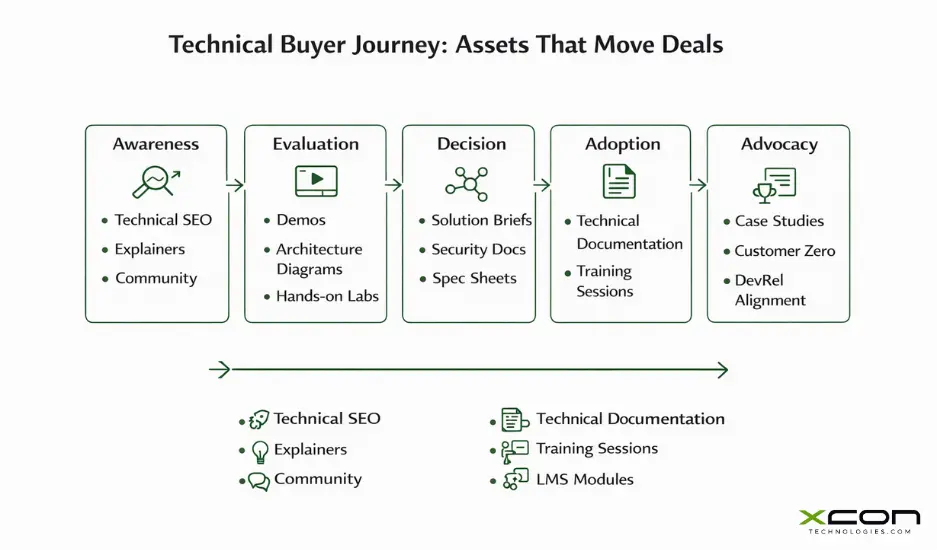
A strong technical marketing function supports the whole customer journey:
- Awareness: technical SEO, explainers, community engagement
- Evaluation: demos, solution briefs, case studies, hands-on labs
- Decision: security docs, ROI proof, integration guides
- Adoption: onboarding, training sessions, in-product education
- Advocacy: Customer Zero stories, developer-facing products content, DevRel alignment
The Technical Marketer’s Arsenal: Essential Skills, Tools, and Outputs
Deep Technical Expertise and Product Understanding
You don’t need to be a senior engineer but you must be fluent enough to:
- map real workflows
- ask smart questions
- confirm claims
- collaborate with product manager + engineering without slowing them down
Common “baseline” knowledge:
- APIs, auth (OAuth, keys), webhooks
- cloud concepts, logging/monitoring
- data handling, privacy, compliance
- basic architecture patterns
Tip: If your SaaS uses AWS services like Amazon DynamoDB, explain why that choice matters.
Key points to focus on include:
- Scalability: How well the system can grow.
- Latency patterns: The delays in response time.
- Access controls: Who can access what data.
Use clear and simple language.
Crafting Compelling Technical Content and Communication
Technical content has to be useful, not fluffy. High-performing assets often include:
- case studies with implementation details (stack, timeline, blockers)
- solution briefs that match real job titles and pain points
- spec sheets for feature parity and procurement
- architecture diagrams for security review and stakeholder alignment
- PowerPoint presentations for internal champions to “sell it upstairs”
- a clean demo library: short clips + deep-dive walkthroughs
Mini checklist: what technical buyers love
- copy/paste examples
- clear prerequisites
- limits and edge cases (honesty builds trust)
- “how to confirm” steps
Strategic Digital Marketing for Technical Audiences
Technical audiences still discover information through search and social media in distinct ways.
- Search Engine Optimization + Technical SEO: topic clusters, schema, internal linking
- structured data: FAQ schema, How To schema, Product/Software Application schema
- Pay-Per-Click Advertising: precise targeting, careful ad spend, strong landing pages
- community-first distribution: developer tools forums, LinkedIn technical threads, GitHub-style examples
- content marketing with a “teach-first” mindset
“How can I conduct a thorough test of [tool] for [use case]? Create pages that provide a direct answer to this.”
Data-Driven Decisions: Analytics, Market Research, and Customer Insights
Technical marketing should be measurable not vibes.
Core tools:
- Google Analytics, Google Search Console, Google Tag Manager
- Google Sheets for quick analysis and tracking
- analytics dashboards using BI Tools (Looker, Power BI, etc.)
- market analysis + Market Research (win/loss notes, competitor teardown, review mining)
Track:
- click-through rates
- user engagement metrics (time on page, scroll depth)
- demo-assisted conversions
- content influence on pipeline in CRM Tools / Customer Relationship Management
Technical Marketing in Action
Enhancing Product Differentiation and Competitive Advantage
In crowded categories, features sound identical. Technical marketing wins by proving:
- speed to integrate
- reliability under load
- security posture
- “how it fits” into real stacks
Use case: If your product is “AI for support,” don’t say “faster resolutions.” Show:
- architecture for human-in-the-loop
- audit logs
- failure handling
- model evaluation approach
Accelerating the Customer Journey for Technical Buyers
Here’s a simple step-by-step playbook SaaS teams can run in 2–4 weeks:
- Pick one high-intent use case Example: “Webhook-driven alerts for SOC teams”
- Map the buyer questions
- solutions architect: security + integrations
- sales engineer: demo paths
- sysadmin: deployment + monitoring
- Build the least asset set
- solution brief + architecture diagram
- demo video + setup guide
- FAQ + troubleshooting
- 1 case study (even if it’s Customer Zero)
- Ship distribution
- SEO page (cluster + internal links)
- LinkedIn post thread
- email to sales teams (enablement pack)
- Measure + iterate
- GSC queries, CTR
- demo conversions
- sales cycle friction notes
Empowering Sales Teams and Partner Ecosystems
Sales teams need “technical proof on demand.” Great enablement looks like:
- demo scripts per persona
- objection handling with evidence
- solution briefs by vertical
- internal training sessions with sales engineer + solutions architect alignment
A technical marketer is often the “Slide-deck builder.” They turn messy info into clear assets that help close deals.
Industry-Specific Applications and Custom Strategies
Technical marketing changes by category:
- Developer-facing products: docs-first, examples, community engagement
- Security SaaS: threat models, compliance mapping, audit artifacts
- Data platforms: performance benchmarks, cost models, integration guides
- AI space: evaluation method, governance, explainability boundaries
Key Performance Indicators (KPIs) for Technical Marketing
Beyond Vanity Metrics: Focusing on Actionable Insights
The views are nice. Outcomes matter:
- Did evaluation get easier?
- Did implementation get faster?
- Did the pipeline move with less friction?
Content Engagement Metrics
Track:
- downloads of white papers / spec sheets
- demo completion rate
- time on page for key technical pages
- conversion rates from “docs → demo request”
Technical SEO Performance
Track via Google Search Console:
- keyword rankings for “how to integrate…”, “best [tool] for…”
- CTR on problem-aware queries
- organic traffic landing on solution pages
- lead generation from SEO pages (tagged in GTM)
Influence on Sales Pipeline, Win Rates, and Deal Velocity
In your CRM:
- assets used per opportunity stage
- influenced pipeline (touchpoints that correlate with stage movement)
- deal velocity (time from demo to proposal)
- win rate shifts for use-case campaigns
Customer Adoption & Retention Metrics
Watch:
- feature usage after onboarding
- documentation access patterns
- fewer repetitive support tickets
- faster time-to-first-value
Customer Surveys and Qualitative Data Analysis
Blend Data Analysis with real feedback:
- short surveys after demos (“What was unclear?”)
- post-onboarding interviews
- sales engineer debriefs
- support engineer ticket tagging trends
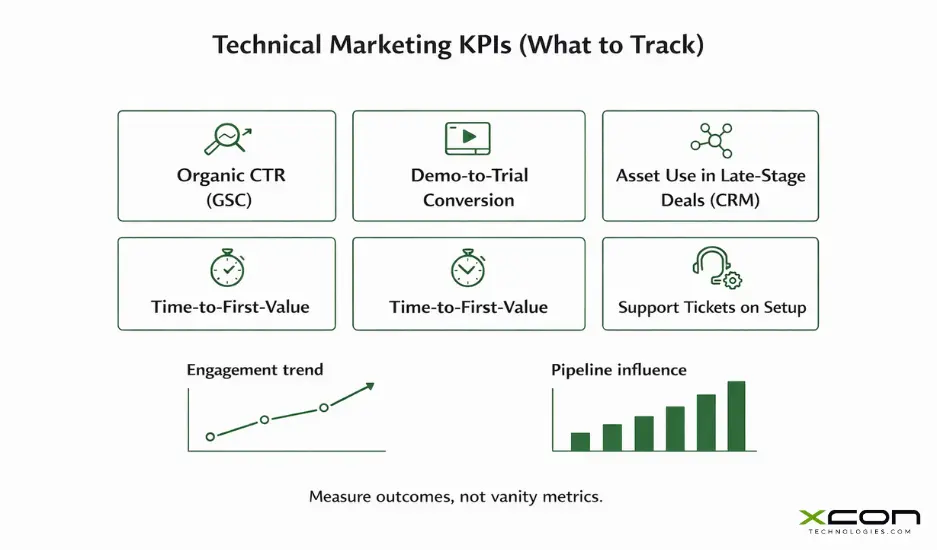
Quick KPI table (copy into a dashboard):
| KPI | Tool | Why it matters |
| Organic CTR on technical queries | Search Console | Shows message-market fit in search |
| Demo-to-trial conversion | Analytics + CRM | Proves demo effectiveness |
| Asset usage in late-stage deals | CRM | Measures enablement impact |
| Time-to-first-value | Product analytics | Adoption indicator |
| Support ticket volume on setup | Support + tags | Shows clarity of docs/labs |
The Future of Technical Marketing: Evolution and Innovation
The Impact of AI and Automation on Technical Content Creation and Personalization
AI helps speed up drafts, variations, and personalization but trust still comes from:
- real product validation
- accurate technical documentation
- examples that work
- honest limitations
Best practice: use AI to speed up formatting and distribution. Don’t use it to create technical truths.
Expanding Roles and Responsibilities
More teams are formalizing “Customer Zero”:
- internal teams use the product first
- issues become content opportunities (guides, labs, demos)
- feedback loops tighten between product management and marketing
Cultivating the “Art” of Technical Storytelling: Making Complex Concepts Accessible and Engaging
Technical storytelling is skill, not fluff:
- one clear problem
- one clear mechanism
- one clear proof
- one clear next step
It’s where “self-expression” counts. The best technical marketers write like real people, not like lifeless spec sheets.
Adapting to Rapid Technological Change: Marketing for Emerging Technologies
In fast-moving categories, your edge is:
- shipping content as the product evolves
- updating architecture diagrams and docs
- refreshing structured data
- maintaining a marketing technology stack that supports quick iteration (CMS + system integrations + tracking)
Conclusion:
Recap: Technical Marketing as the Bridge Between Innovation and Adoption
Technical marketing simplifies SaaS. It makes it clear, testable, and trustworthy. This helps buyers check their options efficiently and adopt with confidence.
The Strategic Imperative for Businesses with Technical Products
If your growth depends on technical decision-makers, this isn’t optional. The strongest teams treat technical marketing as a revenue lever, not a “nice-to-have.”
The Dynamic and Rewarding Career Path for Technical Marketers
This path is high-impact and in demand. It’s helpful for product marketers who want to learn tech skills. It’s also good for sales engineers moving to marketing. Builders from product management can benefit too.
FAQ
No. You need technical literacy enough to understand architecture, APIs, and real workflows. Light scripting helps, but your main job is clarity, proof, and communication.
They create technical content like docs, demos, and solution briefs. They also support sales teams and enhance technical SEO, and also collaborate with product managers and engineers. Together, they turn features into tools that boost adoption.
DevRel focuses on community and developer advocacy. Technical marketing centers on evaluation and buying journeys. It includes proof assets, demos, technical landing pages, and enablement. These elements help drive pipeline and adoption.
Track assisted conversions (docs to demo/trial).
Check influenced pipeline in CRM.
Measure time to first value.
Aim to reduce support tickets.
Combine analytics dashboards with qualitative feedback from sales engineers and support.
Choose one key use case. Create a small asset bundle that includes a solution brief, diagram, demo, and FAQ. Then, publish it with good internal links and structured data. After that, measure search queries, conversions, and sales feedback.