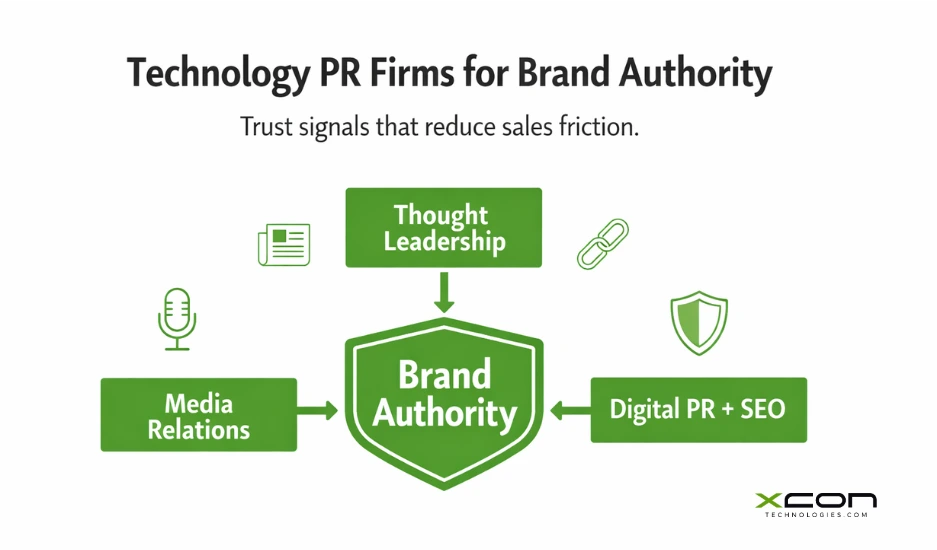
Technology PR firms help scaleups gain credibility. They do this through media relations, thought leadership, and evidence-based storytelling, securing media spots in key outlets. They craft stories that simplify complex products into clear results and also use digital PR to boost search performance. Done well, PR reduces sales friction, increases inbound demand, and strengthens reputation management.
The Imperative of Brand Authority in the Competitive Tech Landscape
Why Brand Authority is Non-Negotiable for Tech Companies Today
Brand authority lowers friction across the whole business:
- Shorter evaluations: Buyers trust you sooner, so fewer “prove it” loops.
- Higher close rates: Credibility becomes a silent deal-closer in enterprise sales.
- Better hiring: Top candidates want to join respected teams.
- Pricing power: Authority protects margin when competitors undercut.
In industries like fintech, healthtech, and cybersecurity, buyers need third-party validation. They look for credible media features, customer proof, and recognized expertise. Without these, they often won’t move forward.
The Evolution of Brand Building: From Hype to Credibility
Old-school launch PR chased buzz: big announcements, louder claims, “hot topic” headlines. Top brands build trust by showing proof. This includes data, case studies, customer results, and validation from trusted third parties.
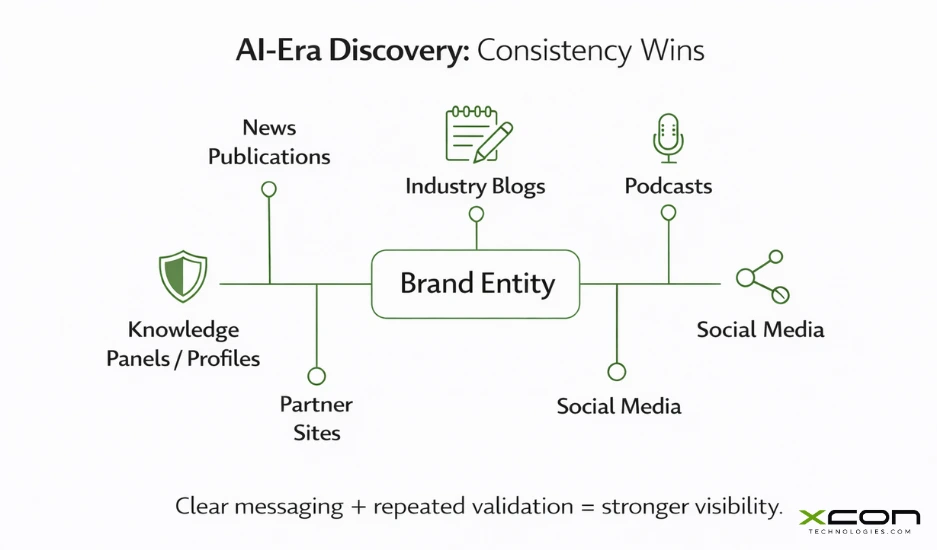
Also, AI-era discovery is changing the rules. AI search likes clear info. It prefers strong authority signals and well-defined entities online. If your messaging is vague or inconsistent, your visibility can drop. This can happen even if your product is great.
Defining “Brand Authority” for Technology Companies
Brand authority means the market trusts your company as the expert in a certain area. This trust is built on proof and reinforced across all channels.
What it looks like in the real world:
- Your leaders are quoted as trusted sources (not “company spokespeople”).
- You get repeat mentions across news publications, industry blogs, and podcasts.
- Analysts and partners show proactive interest.
- You see inbound demand: referrals, demos, and partnership inquiries.
- Branded search and organic traffic rise because people seek you out.
More Than Media Coverage: A Deeper Understanding of Authority
Media coverage is helpful. But, authority comes from reputation, expertise, and consistency not press releases.
Common authority signals
- Speaking slots at credible events and webinars
- Citations in reports, newsletters, and industry roundups
- Reviews and customer proof (case studies, G2-style signals, testimonials)
- Partnerships and integrations that imply trust
- Consistent mentions across digital platforms and social media strategies
The Pillars of Enduring Tech Brand Authority
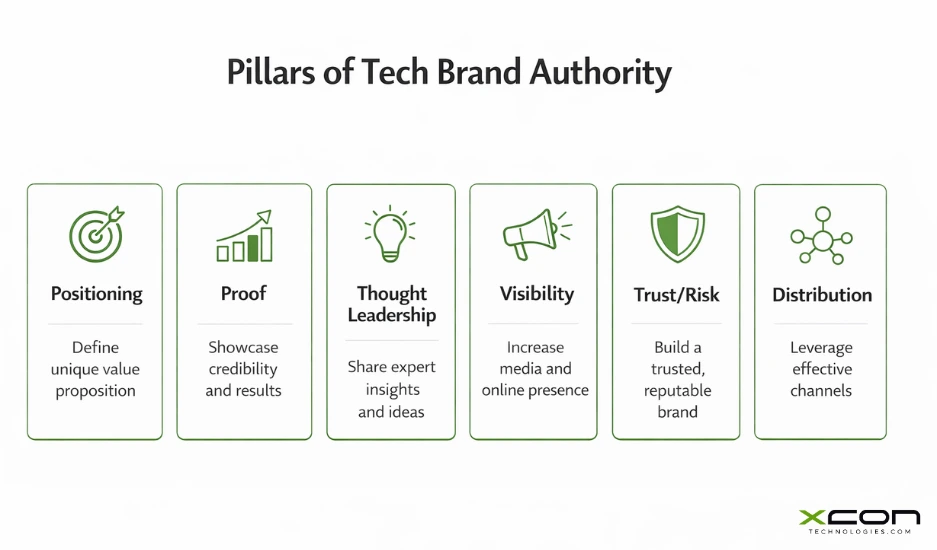
Use this framework to keep PR focused:
- Positioning: A clear “why you” and “why now.”
- Proof: Outcomes, benchmarks, case studies, data visualisations.
- Thought leadership: Strong POVs tied to your category and buyers.
- Visibility: Media outreach + media placements where buyers actually look.
- Trust & risk management: Reputation management + crisis communication readiness.
- Distribution: Content strategy across owned, earned, and partner channels.
Strategic Pillars: How Tech PR Firms Build Authority
A strong tech PR playbook is a system, not random pitches. Top Technology PR Firms build authority through story, proof, distribution, and measurement. They do this every time.
Below is the core system scaleups can expect.
Cultivating High-Impact Media Relations and Earned Media Coverage
This is where media relations becomes an asset not a one-off.
- Targeting: Tier-1 outlets for category legitimacy, plus niche trade for buyer relevance.
- Angle-building: Find storylines that match the outlet’s audience and current narratives.
- Reporter trust: Consistent, accurate, fast responses, no fluff.
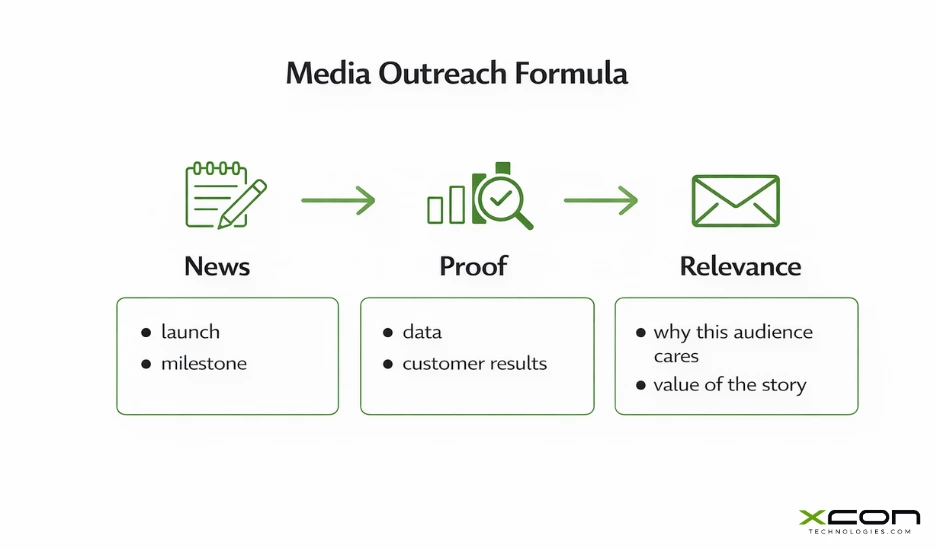
Mini-tip: Use the “news + proof + relevance” formula:
- News: something timely (launch, trend, report, milestone)
- Proof: data, customer outcomes, independent validation
- Relevance: why the outlet’s audience should care right now
Architecting Thought Leadership Programs and Executive Profiling
Founders and executives can become credible voices if the ideas are sharp.
Tactics include:
- POV development tied to your category (not generic “AI will change everything”).
- Bylines that teach, not sell (how-to guides, frameworks, buyer lessons).
- Podcasts, speaking, panels, and “expert commentary” pipelines.
- A consistent cadence so your voice compounds over time.
Narrative Crafting: Translating Complex Tech into Compelling Stories
Great PR turns features into outcomes without dumbing anything down.
A strong narrative often follows: Problem → Solution → Proof → Impact
Examples:
- We reduce admin time for managers by 35% using automated approvals. Twelve teams have verified this.”
Tip: Simplify by removing jargon, not depth. Use one clear analogy, then back it with numbers.
Integrating Digital PR for Amplified Reach and Search Performance
High-performing assets include:
- Data-led reports and benchmark studies (linkable resources)
- “State of the industry” pages built for citations
- Tools, calculators, and explainers that earn links through organic methods.
- Consistent entity and structured messaging to support AI discovery
This supports:
- Link-building PR (quality backlinks)
- Better search engine optimization and on-page SEO alignment
- Stronger search performance for category and branded terms
Proactive Reputation Management and Crisis Communication
Calm, practical crisis readiness protects trust before you need it.
A strong program includes:
- Monitoring brand mentions, sentiment, and risky narratives
- A response playbook (who approves what, how fast, and where)
- Spokesperson training and “fast factual updates” templates
- Post-incident transparency and repair steps
A cybersecurity scaleup could face several challenges, like:
- Online attacks.
- Security solution outages.
- Malformed data exposure.
These issues can disrupt operations and put data at risk.
Confusing error pages can spread quickly. This includes pages with “Cloudflare Ray ID,” “SQL command,” or “site owner bottom of this page.” The fix isn’t panic, it’s rapid clarity, accountability, and proof of remediation.
Specialized PR for Specialized Tech Sectors
Sector depth matters because tech is not one market. Media ecosystems, buyer personas, compliance needs, and sales cycles differ. So, a one-size-fits-all PR approach often falls short.
Understanding the Nuances of Diverse Tech Industries
Common sectors and what changes:
- SaaS: proof + adoption + ROI messaging
- Cybersecurity: trust, third-party validation, response readiness
- Fintech: compliance signals, regulation-aware messaging
- Healthtech: evidence, privacy, credibility with clinicians/buyers
- Climate/energy: impact metrics, policy context, long sales cycles
- Developer tools: community outreach, documentation-led content, demos
Tailored Campaign Development for Unique Industry Challenges
Tailoring usually adjusts:
- Messaging that addresses buyers’ fears, desires, and necessary internal justifications.
- Proof types (benchmarks, audits, case studies, certifications)
- Channels (industry blogs vs mainstream news publications)
- Timelines (enterprise cycles vs SMB demand)
Cybersecurity equals trust, third-party validation, and quick factual communication. It’s also supported by media coverage in reliable outlets.
Measuring the True Impact of Brand Authority: Beyond Vanity Metrics
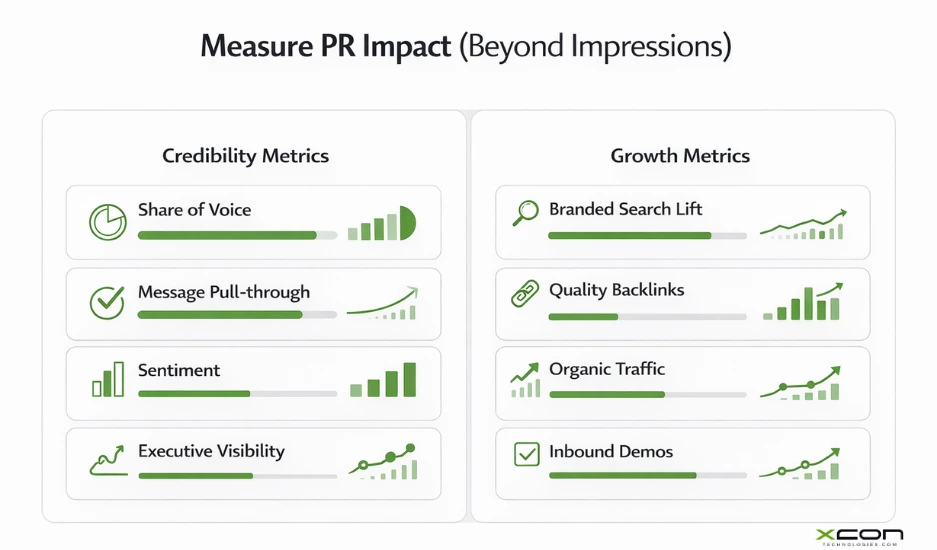
Impressions alone are a trap. They feel good but rarely map to business outcomes. Scaleups need a balanced scorecard that reflects credibility and growth.
Moving Past Impressions: Qualitative and Quantitative Assessment
Metrics that actually matter:
- Share of voice vs competitors (and message pull-through)
- Quality of media features and media placements (buyer-relevant outlets)
- Domain authority lift and links earned via digital PR
- Branded search growth and organic traffic improvements
- Sentiment and reputation stability during pressure moments
- Executive visibility (quotes, invites, repeat mentions)
Connecting PR Efforts to Tangible Business Outcomes
Tie PR to pipeline and revenue influence:
- PR-driven demos and lead generation quality
- Win-rate influence (did credibility remove objections?)
- Sales enablement usage (are reps using media coverage in deals?)
- Partnership interest and inbound from media outlets and communities
Simple tracking suggestions:
- Use UTMs on distributed assets
- Add CRM fields for “How did you hear about us?” and “Credibility factors”
- Run quarterly deal surveys (“Which proof helped you decide?”)
- Track the placements that sales sequences use.
Choosing Your Authority Architect: Selecting the Right Tech PR Firm
Treat this like picking a strategic partner not a vendor. The right firm helps you build brand authority. They use a repeatable system, not random campaigns.
Key Differentiators to Look for Beyond Standard Services
Look for:
- Deep sector expertise (they know your buyers and media ecosystem)
- Strong writing and story craft (real thought leadership, not filler)
- Proven media relations (trusted connections + smart pitching)
- Data/story capability (reports, benchmarks, content creation)
- Founder communications experience (POV, exec profiling)
- Crisis readiness and reputation management maturity
- Reporting rigor tied to keyword goals and business outcomes
You might see companies that are B2B SaaS digital PR agencies. Examples include Otter PR and Bayard Advertising. Don’t choose by name, choose by fit, proof, and process.
The Value of a Firm Aligned with Your Company Culture and Goals
Alignment affects speed, tone, and risk tolerance:
- If your team moves fast, the firm must keep pace without sloppy messaging.
- If your industry is regulated, they must respect compliance workflows.
- Set clear expectations from the start. Focus on cadence, feedback loops, and communication rhythm. This includes weekly updates, monthly reports, and quarterly strategy sessions.
Conclusion:
Scaleups don’t need awareness, they need belief. Strong PR programs build trust by sharing proof-driven stories. They distribute content regularly and measure results well. Over time, authority builds. Sales cycles get shorter, hiring gets better, and your brand becomes the go-to “safe choice” in a busy market.
Reaffirming the Strategic Value of Specialized Tech PR
Three takeaways:
- Credibility > hype in today’s skeptical market
- Proof-led narratives win (data, customer outcomes, third-party validation)
- Consistent distribution + measurement turns PR into a growth system
A Call to Action for Tech Leaders: Elevate Your Brand’s Influence
Request a brand authority audit. It should cover positioning, proof, media readiness, and digital PR gaps. Take this next step! You’ll get a clear roadmap for what to say, where to show up, and how to measure impact without guessing.
Key takeaway: Build trust like a product. Ship proof, earn credibility, and let authority grow.
Quick Pros/Cons: Hiring Technology PR Firms vs In-House
| Option | Pros | Cons | Best For |
| Technology PR Firms | Faster media access, proven systems, broader skills | Cost, onboarding time | Scaleups needing speed + credibility |
| In-house PR hire | Deep product knowledge, daily alignment | Harder to cover writing + media + digital PR alone | Companies with steady news flow |
| Hybrid | Best of both | Needs clear ownership | Growth teams that want compounding output |
FAQs
Most scaleups see early signals in 4–8 weeks (responses, interviews, smaller placements). Strong authority outcomes, like repeat mentions and faster deals, take time. They usually build up over 3 to 6 months. You need steady effort for better search visibility.
No. Digital PR earns coverage and links through stories and data assets. Technical SEO improves site structure and crawlability. They work together to improve search performance. PR builds authority signals, and SEO helps search engines understand and reward those signals.
A proof-led approach: clear positioning, customer outcomes, and consistent thought leadership. Focus on media placements that matter to buyers. Create resources that can be linked. Align PR with sales support. This helps reps use earned media in their deals.
Use a balanced scorecard to track:
Message pull-through
Share of voice
Links/domain authority
Branded search lift
Sentiment
Executive visibility
Pipeline influence
Add simple tracking: UTMs, CRM notes, and deal surveys.
Start where your buyers already learn:
Niche trade publications
Industry blogs
Key newsletters
Targeted podcasts
Once you have proof and traction, step up to larger news publications with timely, data-backed narratives.