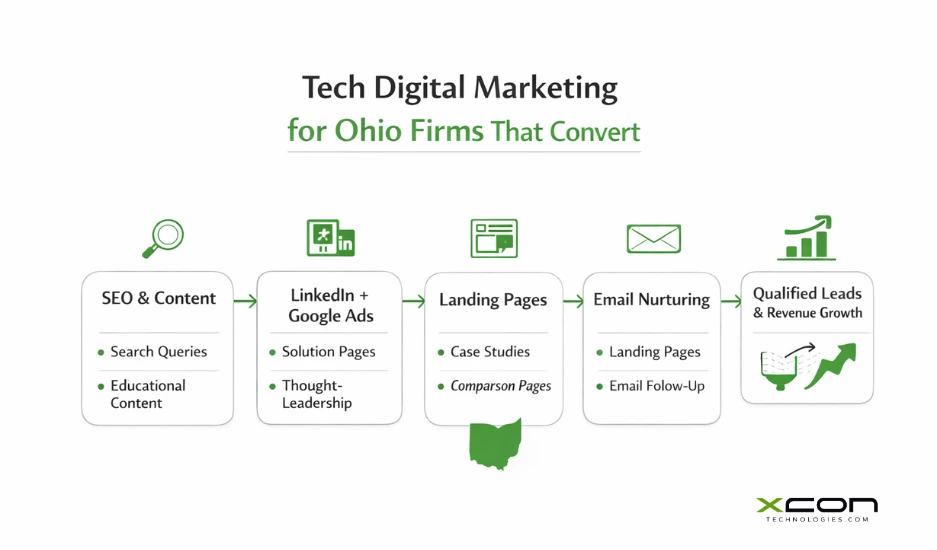
Ohio tech firms do not need more marketing activity. They need better market fit between message, channel, and buyer intent. That is the real job of Tech Digital Marketing: helping a software, IT, SaaS, cybersecurity, managed services, or engineering company turn expertise into visibility, visibility into qualified leads, and leads into revenue.
For most Ohio tech companies, the strongest digital marketing mix is a focused combination of SEO, expert-led content marketing, LinkedIn campaigns, paid search, email nurturing, and conversion-focused landing pages. The winning strategy is usually not “be everywhere.” It is choosing the few channels that match your sales cycle, product complexity, and target buyer, then measuring pipeline impact instead of vanity metrics.
Google’s current guidance continues to prioritize helpful, reliable, people-first content, and Google also advises site owners to think about how content can appear in AI-powered search features. At the same time, B2B marketers are increasing investment in video, thought leadership, paid advertising, and AI-assisted optimization.
Why tech firms need a different marketing approach
Marketing a tech company is not the same as marketing a local retailer or a lifestyle brand.
Most tech buyers are careful, research-heavy, and risk-aware. They compare vendors, involve multiple stakeholders, and move through longer sales cycles. That is especially true in B2B tech, cybersecurity solutions, cloud services, data platforms, and IT consulting.
This changes everything about your content strategy.
A strong approach for technology companies usually needs to do four things at once:
- educate buyers without overwhelming them
- build trust with proof, not hype
- support both demand generation and lead generation
- help sales teams move qualified leads through complex buying decisions
Many generic agencies miss this. They focus on traffic, impressions, or social posting volume when the real question is whether the marketing helps create sales conversations with the right accounts. Several tech-focused agency guides make the same point in different ways: the best results come from strategy, positioning, clear messaging, and channel focus rather than random campaign volume.
Tech Digital Marketing channels that actually drive pipeline
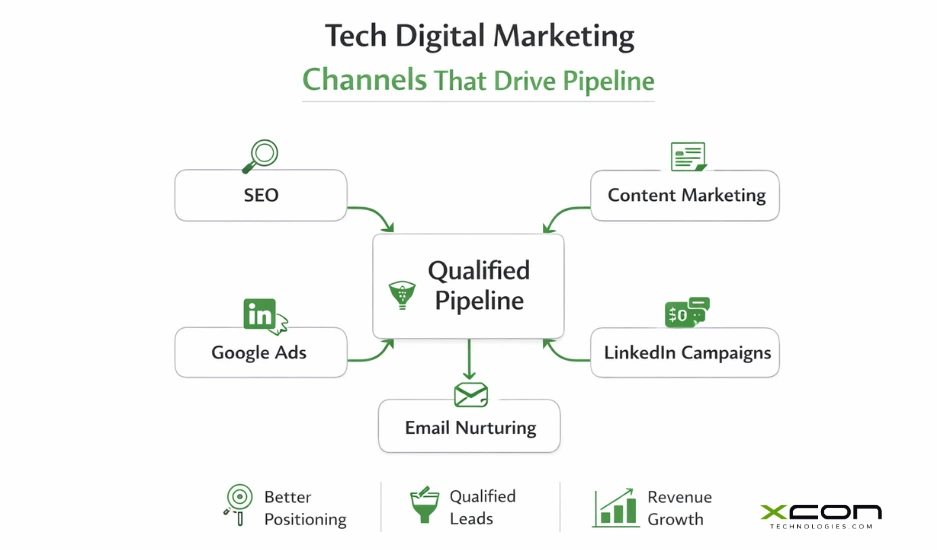
There is no single best channel for every Ohio tech firm. But there are reliable patterns.
SEO and content for high-intent discovery
Search engine optimization and content marketing still matter because buyers search when they are problem-aware, solution-aware, or vendor-aware.
For a tech company, this often means building content around:
- solution pages for core services
- landing pages for industries or use cases
- comparison pages
- implementation guides
- case studies
- FAQs
- thought leadership articles
- technical explainers written in plain language
This is where many firms lose momentum. They publish content that sounds smart internally but does not match how potential customers actually search. Google’s Search Essentials explicitly advises using the words people use to look for content and placing them in prominent locations such as titles and headings. Google also says its systems are designed to reward helpful, reliable, people-first content.
For Ohio tech firms, that often means writing less jargon-heavy content and more buyer-useful content such as:
- “ERP integration for manufacturers in Ohio”
- “how to reduce cloud migration risk”
- “cybersecurity solutions for regional healthcare providers”
- “managed IT support vs internal IT team”
That kind of content does two jobs. It ranks, and it pre-sells.
LinkedIn and paid media for demand capture
For B2B marketing, LinkedIn campaigns and Google Ads can work well when they are tightly aligned with buying intent.
Use Google Ads when people already know the problem and are searching for a provider. Use LinkedIn campaigns when you need to reach specific roles, accounts, or industries before they search.
That matters for Ohio tech firms selling into manufacturing, healthcare, logistics, education, or professional services. The audience may be narrow, but the deal value can justify a focused paid strategy.
A practical split looks like this:
- Paid search for bottom-funnel queries
- LinkedIn ads for account-based marketing and demand generation
- Retargeting for return visits and demo follow-up
- Dedicated landing pages for each campaign theme
- A/B testing on headlines, forms, and offers
LinkedIn’s own lead generation guidance emphasizes campaign design focused on quality leads rather than volume alone, which fits well for B2B tech firms with longer deal cycles.
Email marketing and nurturing for long sales cycles
Email marketing is still one of the highest-leverage channels for B2B online marketing strategies, especially when buying decisions take weeks or months.
Most tech companies do not lose deals because they lack awareness. They lose deals because they fail to stay relevant after the first touch.
A better email strategy includes:
- a segmented email list
- a useful lead magnet or demo offer
- a short drip campaign tied to buyer stage
- sales follow-up based on real user behaviour
- content repurposing across email campaigns, blog content, and social media marketing
This is where many Ohio firms can create an edge. Instead of sending broad newsletters, they can build small, targeted nurture sequences by industry, use case, or service line.
A cybersecurity company, for example, might create separate email campaigns for:
- compliance-focused healthcare buyers
- mid-market manufacturers worried about ransomware
- local government or education buyers evaluating risk and budget
That creates a better engagement rate, stronger brand trust, and more relevant customer interactions.
How Ohio tech companies should choose a strategy
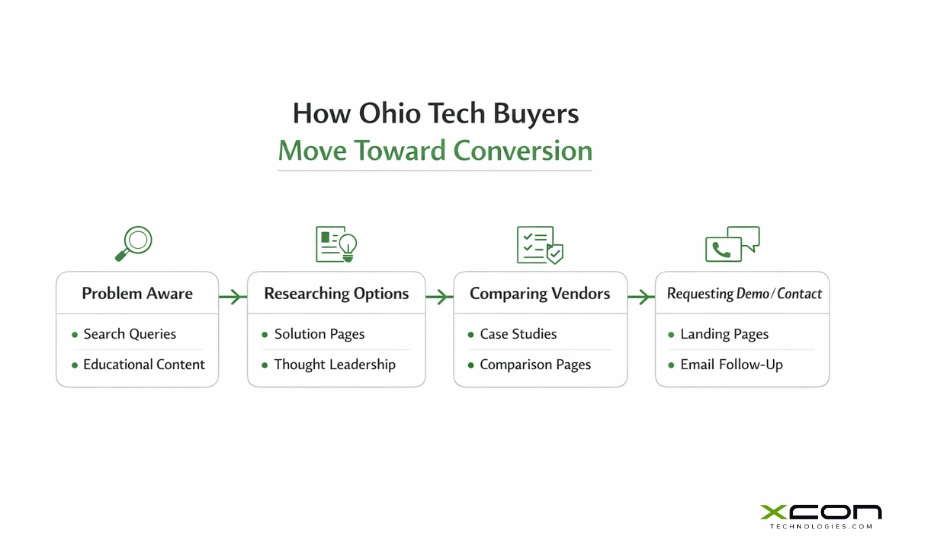
The right strategy depends less on trends and more on commercial reality.
Match channels to business model and deal size
Ask these questions first:
- Is your average deal worth $3,000 or $300,000?
- Do buyers convert on first visit, or after six meetings?
- Are you selling a clear product, a custom service, or a complex security solution?
- Is your market local, regional, national, or niche?
- Do you need inbound marketing, outbound marketing, or both?
A few examples:
Managed IT and local B2B services in Ohio
Prioritize local SEO, service pages, Google Ads, reviews, and fast lead response.
SaaS or platform companies
Prioritize content marketing, search engine optimization, product-led landing pages, email campaigns, and remarketing.
Cybersecurity solutions or complex IT sector offers
Prioritize thought leadership, case studies, webinars, LinkedIn, and sales enablement content.
Firms with enterprise sales targets
Prioritize Account-Based Marketing, strong customer personas, industry pages, and multi-channel campaigns.
Build around proof, not promises
Buyers of tech services do not respond well to vague claims.
They respond to proof like:
- case studies with measurable outcomes
- before-and-after process examples
- implementation timelines
- screenshots or product visuals
- clear pricing logic or buying models
- security, compliance, and service detail pages
- strong customer service signals
This is why the best content marketing for tech companies usually sounds specific, not flashy.
Instead of saying, “We drive growth,” say, “We help Ohio manufacturers reduce IT downtime with managed support and proactive monitoring.”
Instead of saying, “We offer advanced cybersecurity,” say, “We provide endpoint protection, incident response planning, and employee security training for regulated teams.”
Specific language improves brand recognition, trust, and conversion.
A practical framework for Tech Digital Marketing
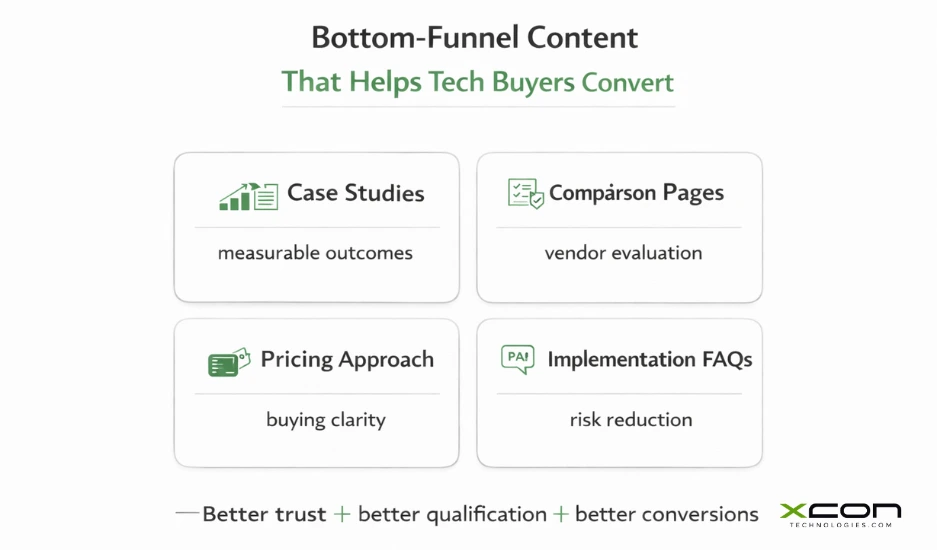
Here is a workable framework for Ohio tech firms that want a clear plan.
1. Clarify positioning
Define:
- who you serve
- what problem you solve
- why your approach is different
- what proof supports the claim
2. Build the right pages
At minimum, create:
- homepage with clear value proposition
- service pages
- industry pages
- case studies
- contact or demo page
- campaign-specific landing pages
3. Create bottom-funnel content first
Start with content that helps commercial investigation:
- comparison pages
- pricing approach pages
- implementation FAQs
- vendor evaluation content
- case studies
4. Add channel support
Then layer in:
- SEO strategies
- Google Ads
- LinkedIn campaigns
- email nurturing
- social media platforms that fit B2B buyers
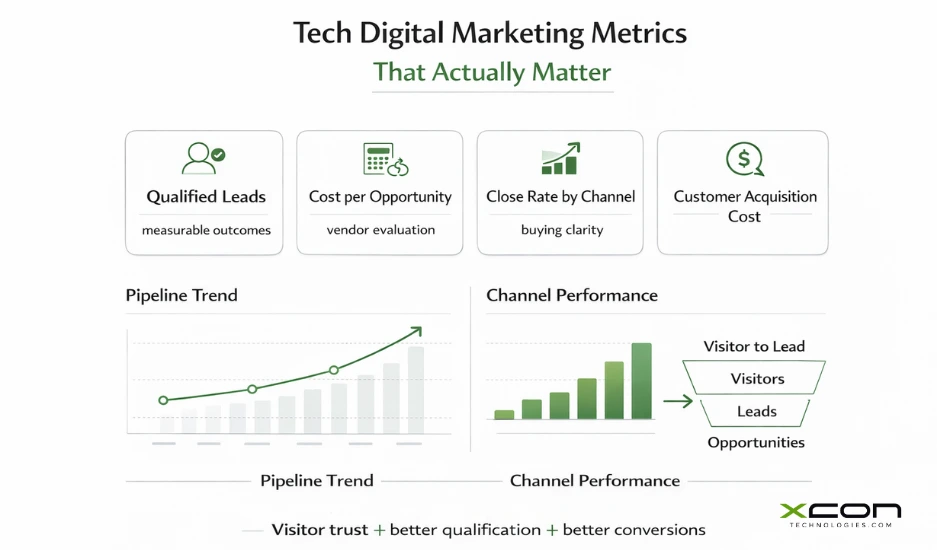
5. Measure business outcomes
Track:
- qualified leads
- sales accepted leads
- cost per opportunity
- customer acquisition costs
- close rate by channel
- customer retention where relevant
Do not stop at pageviews or clicks. Those are useful, but they are not the finish line.
What to look for in a digital marketing agency
If your Ohio firm is evaluating a digital marketing agency, compare agencies on fit, not just price.
Look for an agency that can show:
- experience with B2B tech, not just generic digital marketing services
- ability to write for technical and non-technical buyers
- strong content creation and paid media execution
- a clear reporting model tied to pipeline
- strategic thinking on conversion paths, not just traffic
- understanding of privacy changes, attribution limits, and modern buyer journeys
Privacy changes and the decline of third-party cookies have made first-party data, CRM discipline, and stronger content ecosystems more important. Google’s AI search features also raise the value of content that is clear, reliable, and easy to extract.
That means a capable agency should be able to discuss:
- first-party data collection
- CRM and attribution
- content repurposing
- answer-focused site structure
- video marketing and visual content
- brand identity and trust signals
- A/B testing and analytics
If the agency mostly talks about impressions, followers, or posting frequency, keep looking.
Common mistakes tech firms make
Here are the mistakes that show up again and again.
1. Choosing channels before strategy
A company starts posting on every social media platform before it has clear positioning or a conversion path.
2. Writing for insiders only
The copy makes sense to engineers but not to buyers, finance leads, or operations decision-makers.
3. Sending paid traffic to weak landing pages
Clicks are bought, but landing pages are vague, slow, or not built for conversion.
4. Publishing top-of-funnel content only
Traffic grows, but lead generation stays flat because the content never helps decision-stage buyers.
5. Measuring vanity metrics
The dashboard looks healthy, but pipeline and revenue do not move.
6. Treating AI as a shortcut
Generative AI can help with research, drafts, testing ideas, and content repurposing, but weak positioning and generic messaging still produce weak outcomes. Google’s guidance does not reward content just because it exists; it rewards content that is useful and reliable.
Key takeaways
- The best digital marketing for tech companies is focused, not scattered.
- SEO, content marketing, Google Ads, LinkedIn, and email marketing often work best together.
- Ohio tech firms should build around buyer intent, proof, and measurable pipeline impact.
- Landing pages, case studies, and nurture sequences often matter more than posting more often.
- A strong agency should understand B2B tech, attribution, and long sales cycles.
- Helpful, reliable, clearly structured content is increasingly important for both traditional search and AI-driven search experiences.
Conclusion
Digital marketing for tech companies works best when it is tied to how tech buyers actually buy.
For Ohio firms, that usually means fewer random tactics and more strategic alignment between messaging, search intent, paid acquisition, content depth, and conversion design. The companies that win are not always the loudest. They are the clearest, the most credible, and the easiest to trust.
If your team wants a cleaner growth system, start with positioning, build better landing pages and case studies, then connect SEO, paid media, and email into one measurable engine.
Explore your current site, messaging, and growth opportunities at XCon Technologies.
FAQ
There is no universal best channel. For many B2B tech firms, the strongest mix is SEO, content marketing, LinkedIn, paid search, and email nurturing. The right balance depends on deal size, buyer journey, and market focus.
Yes, but usually in a narrower way than for consumer brands. LinkedIn is often the most useful social platform for B2B tech because it supports role targeting, thought leadership, and account-based campaigns.
Paid campaigns can produce early signals quickly, but search engine optimization and content strategy usually take longer to compound. For firms with longer sales cycles, meaningful revenue impact often depends on consistent execution across several months.
Yes. Content marketing helps tech firms educate buyers, build trust, rank for relevant searches, support email campaigns, and improve conversion quality. It is especially useful when products or services require explanation.
Qualified leads. Traffic matters only when it attracts the right visitors and moves them into the marketing funnel.