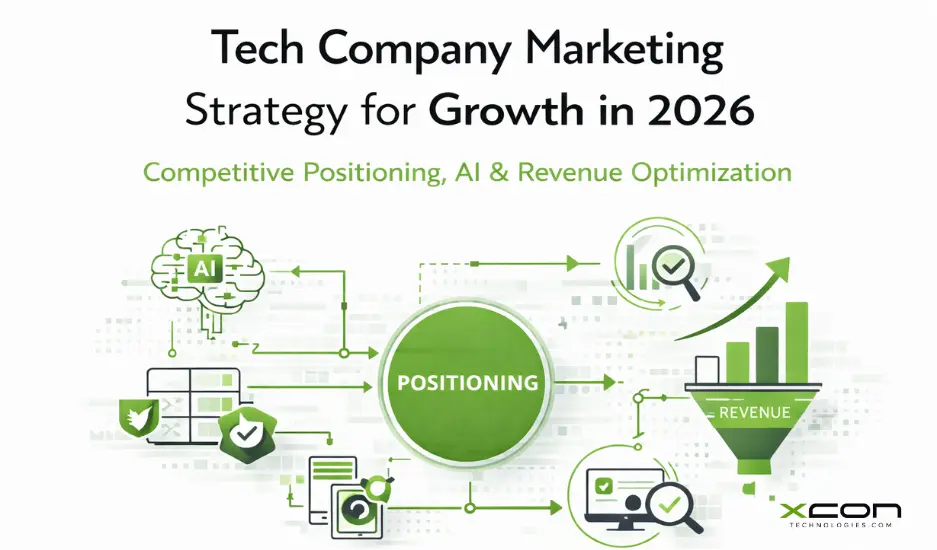
Tech Company Marketing in 2026 works best when it ties brand awareness to revenue-driven goals. That means clear positioning, better use of Generative AI, tighter multi-channel integration, and sharper conversion tactics across the full customer journey.
Most tech brands do not have a traffic problem. They have a clarity problem. They launch campaigns across social media platforms, paid social, Email Marketing, search engine optimization, and video marketing, yet revenue growth stays uneven. The issue is usually not effort. It is the lack of a focused system that connects positioning, content strategy, first-party data, CRM workflows, and lead conversion rates.
The strongest tech company marketing strategy in 2026 is not channel-first. It is market-first and conversion-led. CMOs should build around competitive positioning, high-intent content, AI-powered personalization, first-party data, and measurable pipeline impact. Brands that do this well create a connected system where content, paid media, SEO, customer support, and sales enablement all move in the same direction.
What Tech Company Marketing looks like in 2026
The market has changed. Buyers now move through customer discovery pathways faster, but they also verify more before they engage. They compare vendors across algorithmic feeds, search results, review content, virtual demos, creator content, and peer recommendations.
That shift has changed the job of marketing.
In 2026, effective tech marketing needs to do five things well:
- create clear category positioning
- build trust early with useful content
- capture and use first-party data responsibly
- improve lead-converting AI and CRM workflows
- support the full sales funnel, not just top-of-funnel reach
This matters across sectors. A software platform, Renewable Energy provider, smart tech company, Energy Solutions brand, or Supply Chain Planning platform all need the same strategic backbone. The story, channels, and buyer motions may differ, but the operating logic stays the same.
The 2026 strategy model CMOs should use
A strong strategy starts with sequence. Many teams still jump straight to paid media or creative optimization. That approach often increases spend before it improves direction.
A better model is built in three layers.
1. Positioning before promotion
Start with the market story.
Ask these questions first:
- What do we want to be known for?
- Which buyer problem do we solve better than others?
- Where is our competitive positioning weak or unclear?
- What proof supports our message?
- How should our brand storytelling sound across channels?
If the answers are fuzzy, the downstream work gets expensive. You can run PPC (Pay-Per-Click Advertising), social media campaigns, and influencer partnerships all quarter long, but weak positioning will lower engagement rate and reduce conversion.
This is where many disruptor brands win. They do not always outspend larger firms. They communicate faster and more clearly.
2. Channel mix built around buying behavior
Once positioning is clear, build a channel plan that matches how your audience actually evaluates solutions.
For many B2B and tech-focused brands, that mix now includes:
- search engine optimization for active demand
- content marketing for education and trust
- video marketing for product clarity and proof
- paid social for targeted awareness and retargeting
- Email Marketing for lead progression
- live and virtual conferences for deal acceleration
- landing pages tailored to buying stage and audience segment
This is where CMOs need discipline. Not every channel deserves equal budget. The best marketing plan reflects buying behavior, deal size, and sales cycle length.
For example, a company selling AI agents or digital twins may need technical content, product walkthroughs, comparison pages, and expert analysts in webinars. A consumer-facing smart tech brand may rely more on creator content, paid social, retail media networks, and short-form video platforms.
3. AI, data, and conversion systems
Generative AI is now part of the operating model, not a side experiment. But the useful question is not whether to use it. The useful question is where it improves speed, relevance, or decision quality.
In 2026, practical uses include:
- AI-powered personalization on landing pages
- lead-converting AI for early qualification
- faster A/B testing of offers, creative, and messaging
- content research support using generative AI tools
- customer service and customer support workflows
- synthetic data models for faster scenario testing where appropriate
That said, AI does not replace strategic judgment. It amplifies it. A weak strategy scaled by AI still produces weak outcomes faster.
Where many tech brands still waste budget
A lot of underperformance looks sophisticated from the outside.
Common budget traps include:
- posting on every social media channel without clear purpose
- chasing reach instead of customer lifetime value
- overproducing content without mapping it to the customer journey
- running SEO Optimization without fixing weak pages or intent mismatch
- investing in flashy Digital Innovations that do not help pipeline
- using Generative Engine Optimization language without building citable, useful content
Another common issue is fragmented execution. One team owns a search. Another owner paid and handles customer insight. Another manages CRM workflows. No one owns the full system.
That is why multi-channel integration matters. It turns scattered activity into a measurable growth engine.
How to evaluate a marketing partner or agency
For CMOs with commercial investigation intent, the real question is not just what to do. It is who can help execute it well.
Whether you are reviewing an internal team, specialist firm, or outside partner, look for these signals:
- they talk about revenue impact, not vanity metrics
- they can explain how brand awareness connects to pipeline
- they understand content strategy and conversion design together
- they know how to improve search, paid, email, and video as one system
- they ask about sales funnel friction, not just campaign output
- they can adapt strategy for your category, whether that is Urban Planning, Patient Experiences, Smarter Jobsites, or Home Technology Zone style audiences
The right partner should be able to show how messaging, media, measurement, and conversion tactics connect. That is what separates activity from progress.
Key takeaways
A strong 2026 approach to Tech Company Marketing should be built on a few clear principles:
- clarity beats noise
- positioning shapes performance
- first-party data is more valuable than borrowed reach
- Generative AI is useful when tied to outcomes
- every channel should support customer movement, not just visibility
- the best strategies connect brand, demand, and conversion
For CMOs, the test is simple. If marketing creates attention but not forward movement, the system needs work.
Conclusion
The brands that win in 2026 will not be the loudest. They will be the clearest, the most relevant, and the easiest to trust.
Tech Company Marketing now demands a tighter link between message, data, channel mix, and customer movement. CMOs who build that connection will be in a stronger position to improve revenue, sharpen market presence, and make better use of both human expertise and AI systems.
If you are reviewing partners or refining your next strategy cycle, start by auditing your positioning, conversion paths, and channel alignment. That will show you where growth is actually being lost. For teams exploring outside support, xCon Technologies is one place to review strategic and execution options.