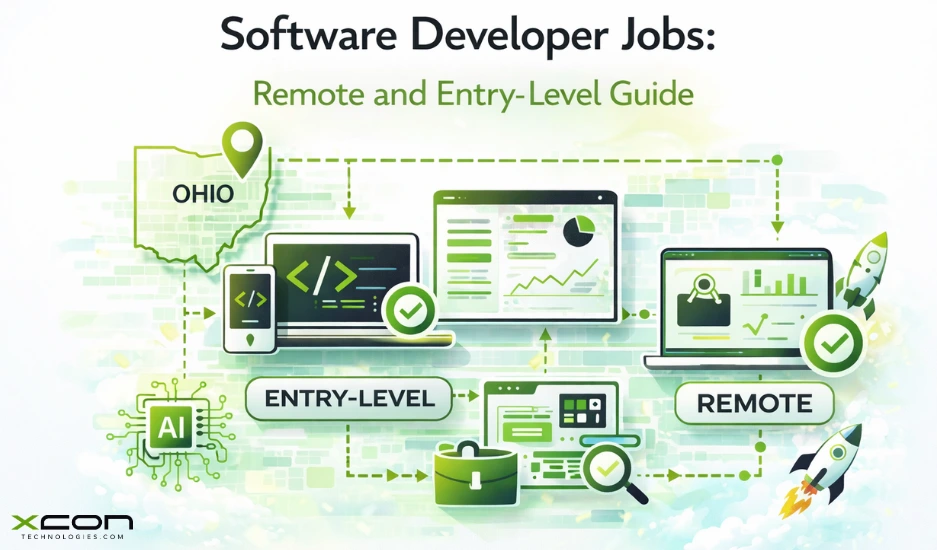
Software developer jobs still offer strong opportunities for new and experienced candidates, especially in remote teams, product companies, agencies, startups, and AI-focused businesses. Entry-level roles often start in web, QA automation, support engineering, or junior product teams. For US job seekers, the best results come from targeting practical skills, portfolio proof, and role fit instead of applying broadly.
Software developer jobs remain one of the most practical career options for people who want strong long-term demand, flexible work models, and clear growth paths. In the United States, employers still need developers who can build products, improve internal systems, support digital operations, and work with AI-driven tools.
Remote hiring remains important, but employers have raised their standards. They want candidates who can communicate clearly, ship real work, and understand business outcomes. That matters even more for entry-level applicants.
For many candidates, the fastest path into the field is not chasing the most glamorous title. It is finding the role where their skills solve a real need. That may be web development, mobile app support, product engineering, QA automation, integrations, or internal software tools.
Ohio adds another layer of opportunity. The state has growing demand across healthcare, logistics, manufacturing, education, and professional services. Many Ohio businesses need digital products, better websites, workflow automation, and custom internal systems. That creates openings for developers who understand both code and business use cases.
Remote vs Entry-Level Roles
Remote roles focus on the work model. Entry-level roles focus on experience level. A remote junior role exists, but it usually goes to candidates who already show proof of work through projects, internships, freelance work, or strong GitHub activity.
Entry-level openings often appear under different titles, such as:
- Junior Developer
- Associate Software Engineer
- Front-End Developer
- QA Automation Engineer
- Application Support Developer
- WordPress or CMS Developer
- Implementation Engineer
- Technical Solutions Analyst
Many companies also hire junior talent into adjacent roles that lead into engineering later. That route works well for people who need experience before moving into full product development.
Where New Developers Find the Best Openings
New developers often get better results when they focus on role clusters instead of one exact title.
Web and platform teams
These roles fit candidates with HTML, CSS, JavaScript, React, CMS platforms, APIs, and performance basics.
App and product teams
These roles suit candidates with mobile app knowledge, backend APIs, testing, product thinking, and version control habits.
Internal tools and business systems
Many small and mid-sized US companies need developers for dashboards, admin systems, automation workflows, reporting tools, and integrations.
AI automation and process support
This area is growing fast. Companies need people who can connect tools, automate workflows, handle data movement, and support AI-enabled operations.
That range matters because job seekers often ignore roles that do not say “software engineer” in the title, even when the work builds the same core experience.
Best option for different job seekers
The best path depends on your background.
Best option for computer science graduates
Target junior product, backend, QA automation, and full-stack roles. Pair coursework with a portfolio and one polished real-world project.
Best option for self-taught developers
Target web development, support engineering, CMS, frontend, and automation-heavy roles. Show shipped work, not just tutorials.
Best option for career switchers
Target implementation, technical support, QA, low-code automation, and internal systems roles first. These jobs often value business context.
Best option for Ohio-based candidates
Look at hybrid and regional employers, not only national remote listings. Ohio companies often hire for practical digital work tied to operations.
What employers actually look for
Employers want evidence that you can contribute with limited ramp-up time. That usually means:
- Clean code and readable structure
- Strong fundamentals in one stack
- Git and collaboration basics
- Problem solving with business awareness
- Clear written communication
- A portfolio that shows real outcomes
A polished portfolio beats a long list of claimed skills. One working app with a clear use case often does more than ten unfinished projects.
Role comparison table
| Role type | Best for | Typical skills | Hiring difficulty | Growth potential |
| Junior Web Developer | New developers with frontend skills | HTML, CSS, JavaScript, React, CMS | Moderate | Strong |
| QA Automation Engineer | Detail-oriented entry-level candidates | Testing, scripting, automation tools | Moderate | Strong |
| App Support Developer | Candidates with product and debugging interest | APIs, logging, support workflows | Lower to moderate | Good |
| Full-Stack Junior Developer | Candidates with broader project experience | Frontend, backend, databases | Higher | Very strong |
| AI Automation Specialist | Candidates with workflow and tool integration skills | APIs, automation, data flows, prompts | Moderate | Very strong |
Pros and Cons
Pros
- Strong long-term demand across industries
- Multiple entry points, not just one job title
- Remote work still exists in many teams
- Skills transfer across web, apps, and automation
- Good growth from junior to specialist roles
Cons
- Entry-level competition is high
- Remote roles attract national applicant pools
- Employers expect proof of practical ability
- Generic portfolios get ignored quickly
- Tool trends change fast, so learning must stay active
Common mistakes to avoid
A common mistake is applying to every listing with the same resume. That lowers response rates. Tailor your resume to the role type.
Another mistake is building a portfolio full of clones. Employers want to see how you think, structure work, and solve problems.
Many applicants also chase remote-only roles too early. That narrows options. A hybrid or regional role can build the experience needed for a stronger remote move later.
Some candidates ignore business-facing skills. That hurts them. US employers often prefer developers who understand users, operations, revenue impact, or workflow efficiency.
Finally, do not overload your profile with every framework you have touched. Depth wins over keyword stuffing.
How to improve your chances faster
Focus on a narrow lane first. Pick one of these four:
- Web development
- App development
- Software product development
- AI automation and integrations
Then build proof around that lane. A strong portfolio can include a client dashboard, a simple mobile app, a high-performance site rebuild, or an automated workflow tied to a business problem.
This also creates natural relevance for service-driven businesses. Companies that hire developers often need broader support in software development, app development, web development, or AI automation after initial product growth. That makes role experience in those areas more valuable than ever.
For Ohio candidates, it also helps to understand local business demand. Regional firms often prioritize maintainable systems, faster workflows, and practical ROI over flashy tech stacks.
Key Takeaways
- Target role clusters, not only one exact title.
- Show real work through portfolio projects and shipped outcomes.
- Use regional and hybrid roles to build experience faster.
- Focus on one skill lane before expanding your stack.
- Business awareness improves your chances in US hiring markets.
FAQs
Yes. They still offer value, but competition is higher, so candidates need stronger portfolios, clear communication, and role fit.
Usually 0 to 2 years of experience, plus proof of skills through projects, internships, freelance work, or technical support roles.
Yes. Many hire for hybrid, in-office, and practical digital roles tied to operations, internal tools, websites, and apps.
Yes. It builds core coding, UI, API, and performance skills that often transfer well into product, app, and automation work.
Conclusion
Software developer jobs remain a strong path for US job seekers who focus on practical skills, visible proof, and the right role type. Remote and entry-level opportunities still exist, but success now depends on relevance more than volume. Choose a clear lane, build real examples, and apply where your work matches business needs.