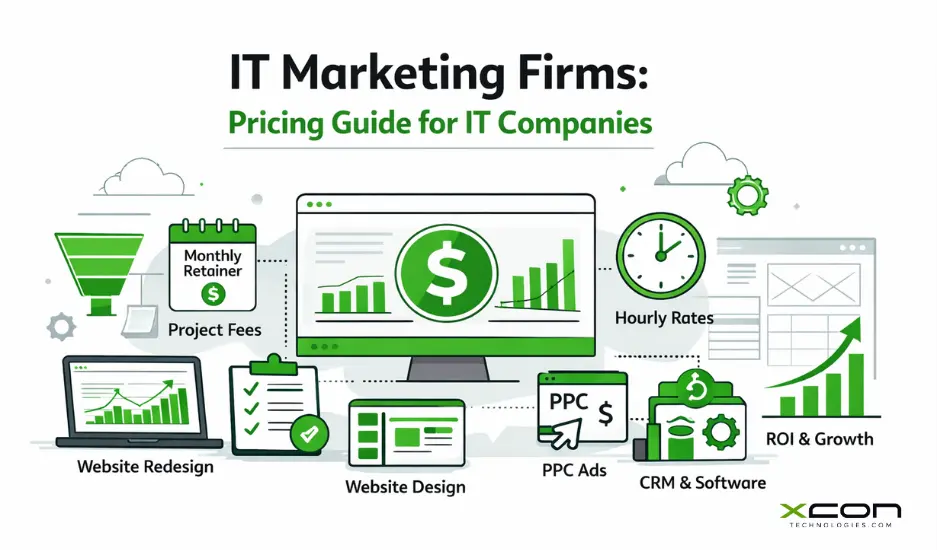
Hiring help for growth is not hard. Hiring the right help at the right price is where most IT companies get stuck. When IT companies compare IT Marketing Firms, the real question is not “What is the cheapest option?” It is “What level of strategy, execution, and measurable pipeline impact are we actually buying?”
For most US and Ohio-based IT companies, a realistic budget starts around $3,000 to $12,000+ per month for ongoing agency support, while consulting can run $50 to $500 per hour and project work can range from $1,000 to $50,000+. A website redesign often lands between $3,000 and $75,000, PPC management is commonly priced at 10% to 20% of ad spend, and CRM or email platforms may add separate software costs.
What IT Marketing Firms Usually Cost
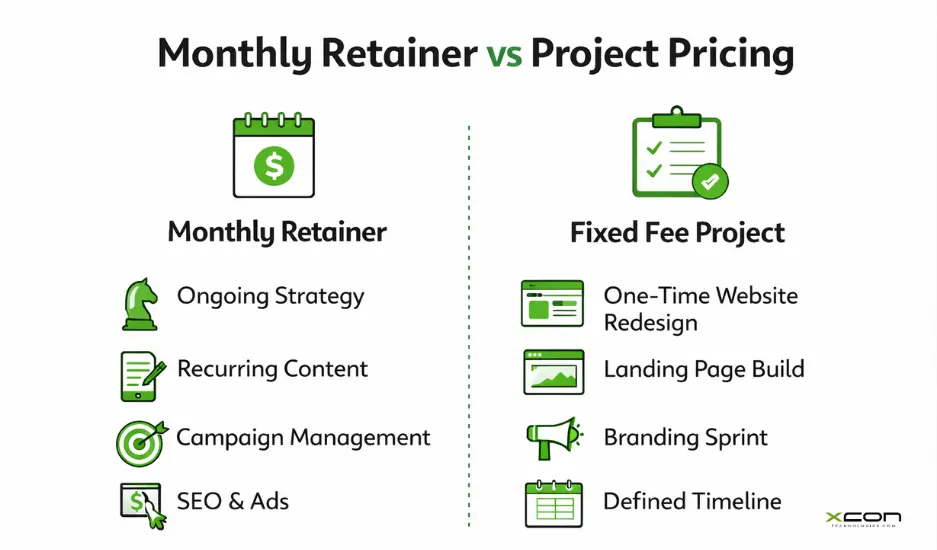
The biggest pricing mistake IT companies make is comparing quotes that are built on completely different billing structures. One firm may quote only strategy. Another may include campaign management, content creation, landing pages, PPC advertising, and reporting.
Monthly retainers
Retainer fees are the most common model for ongoing digital marketing strategies. They usually make sense when you need recurring support with search engine optimization, content marketing, email marketing, social media management, paid advertising, campaign funnels, and reporting.
Published agency benchmarks show monthly retainers ranging from about $1,000 to $12,000+, with broader digital marketing programs stretching higher depending on scope. Service-specific ranges also vary widely: SEO may run $1,000 to $30,000 per month, PPC $1,500 to $10,000, email marketing $300 to $5,000, and social media marketing $1,000 to $20,000.
For an IT company, that usually means:
- $3,000 to $6,000/month for focused work such as SEO, blog posts, one email newsletter, light organic social media, and a few landing pages
- $7,000 to $15,000/month for a stronger mix of content strategy, Google Ads, paid social media, campaign management, and conversion-focused reporting
- $15,000+/month for multichannel campaign execution, heavier content creation, advanced CRM software workflows, video content, and more specialized B2B strategy
Fixed fee and project pricing
A fixed fee works well when your scope is clear. That might include a website build, website redesign, logo design, brand design, a set of landing pages, or a defined content strategy sprint.
General agency project pricing often falls between $1,000 and $50,000+, while website redesign pricing commonly ranges from $3,000 to $75,000, depending on site size, design complexity, integrations, copy, and functionality.
This model is usually better than a retainer when you want a clear deliverable, a fixed timeline, and less ongoing dependency.
Hourly billing and time-and-materials
Hourly pricing or a Time and Materials model is common for audits, consulting, short-term troubleshooting, or extra work outside the main scope. Agency benchmarks place hourly billing around $50 to $500 per hour.
This can be a smart fit when your in-house team already handles execution and only needs a marketing consultant for strategy, PPC troubleshooting, SEO direction, or campaign review. It becomes expensive when the scope is vague or keeps expanding.
Performance-based pricing
Some firms offer a performance-based model, value-based billing, or performance-based fees tied to leads, traffic, or sales outcomes. On paper, this sounds attractive. In practice, it needs very clear attribution.
PPC management is often priced as a percentage of spend, with many reports clustering around 10% to 20% of ad spend. So if your company spends $8,000 on digital ads, management alone may add roughly $800 to $1,600 before creative, landing page work, or CRM integration. That is a useful example of why media spend and agency fees should be separated in every proposal.
What changes the price for IT companies
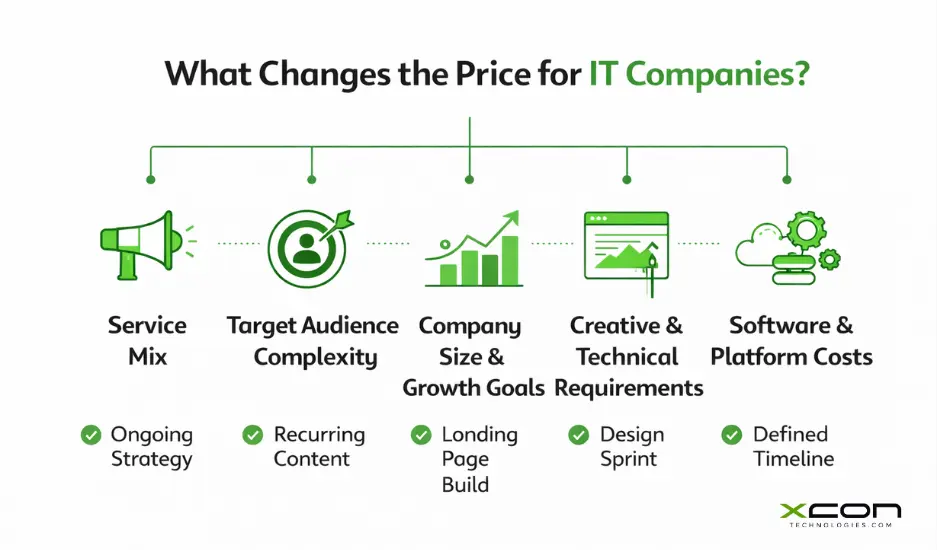
Two firms can both call themselves a marketing agency and still be selling completely different things. For IT companies, price usually moves based on five factors.
1. Service mix
A firm handling only local SEO and blog posts will cost far less than one managing website design, content marketing, paid advertising, video ads, social media channels, and email automation.
2. Target audience complexity
Selling managed IT services to local businesses is different from selling cybersecurity, SaaS, cloud consulting, or enterprise software to multiple stakeholders. Longer sales cycles require better messaging, stronger campaign funnels, and more precise content creation.
3. Company size and growth goal
A small Ohio IT company trying to increase website traffic has a different budget than a scaling SaaS firm chasing market share and lower customer acquisition cost.
4. Creative and technical requirements
Graphic design, branding services, landing pages, website redesign, video content, and CRM software setup all add labor and specialist time.
5. Hidden operating costs
Technology fees, licensing fees, platform fees, travel costs, printing materials, and tool subscriptions can sit outside the quoted management fee. HubSpot, for example, prices Starter by seat and notes that upgrades may be required when limits are exceeded. Mailchimp pricing also scales by plan, contacts, and email volume, with overages possible.
Marketing firm vs. in-house team
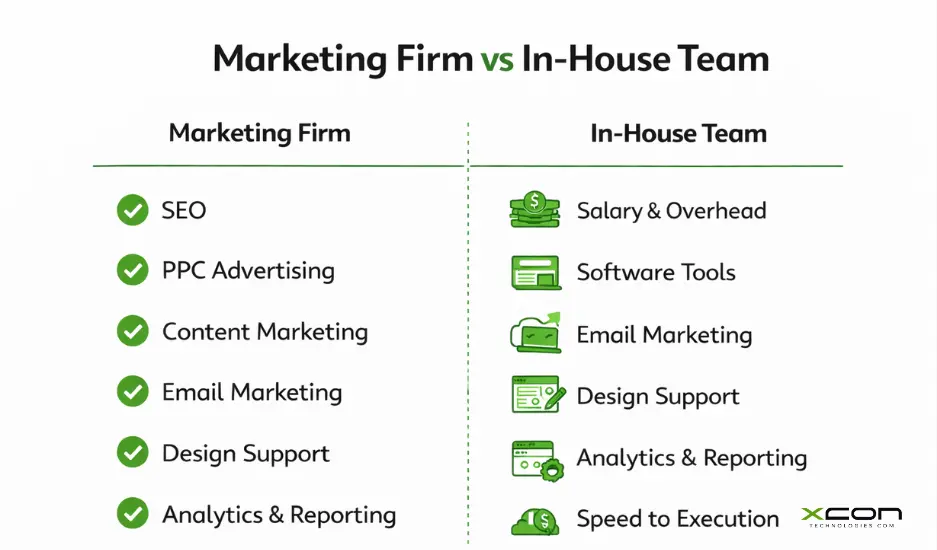
This is where the comparison gets more honest.
Nationally, the U.S. Bureau of Labor Statistics reports a median annual wage of $161,030 for marketing managers. Ohio state wage data lists marketing managers at about $140,500 annually on average.
That does not mean an in-house team is wrong. It means the comparison should be fair.
One in-house hire may give you focus and internal knowledge. But it rarely gives you all of this at once:
- SEO and local SEO
- PPC advertising and digital advertising
- social media marketing
- email marketing and automation
- website design and landing page optimization
- Graphic Design and Brand Design
- analytics, reporting, and campaign management
That is why many IT leaders compare IT Marketing Firms against the fully loaded cost of building several specialist functions, not against one salary line.
A practical budget framework for Ohio IT companies
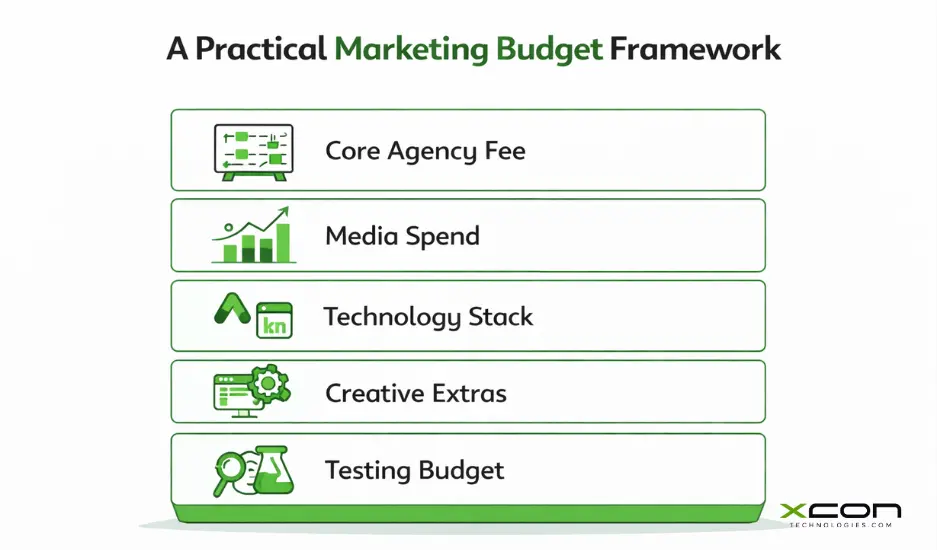
If your company sells IT support, software, cloud services, or managed services, budget in layers instead of chasing a single number.
Start with this simple framework:
- Core agency fee for strategy and execution
- Media spend for Google Ads, LinkedIn, or paid social media
- Technology stack for CRM software, email marketing, analytics, or automation
- Creative extras for website build, graphic designer support, video content, or branding services
- Testing budget for new landing pages, offers, and campaign funnels
For a broader benchmark, SaaS Capital reports that private SaaS companies spend a median of 8% of ARR on marketing. That is not a rule, but it is a useful directional number for IT companies with recurring revenue models. A $2 million ARR business, for example, would be looking at roughly $160,000 per year, or about $13,300 per month, across agency fees, media spend, software, and content.
That budget does not need to go to one vendor. But it does help you judge whether a quote is unrealistic, under-scoped, or actually aligned with your growth plan.
How to compare proposals without overpaying
Before signing with any marketing firm, ask these questions:
- What is included in the monthly fee, and what is billed separately?
- Is ad spend included, or is it a separate media spend line?
- Are website updates, landing pages, blog posts, and email newsletter production included?
- Which performance indicators will be reported every month?
- Will the firm help with customer lifetime value, customer acquisition cost, and conversion tracking?
- Are platform fees, licensing fees, and reporting tools extra?
- Who owns the creative assets, ad accounts, and CRM setup if you leave?
A cheaper quote often excludes strategy, content creation, reporting depth, or conversion work. A more expensive quote may actually be the better cost-benefit analysis if it reduces waste and improves qualified pipeline.
Key takeaways
If you want the short version, here it is:
- Most IT companies should expect mid-four-figure to low-five-figure monthly pricing, depending on scope
- Retainer fees work best for ongoing growth
- Fixed fee projects work best for one-time builds or redesigns
- PPC and paid social media often require separate media spend
- Software, CRM, and email platforms can materially change total cost
- Comparing an agency to one employee is often the wrong math
Conclusion
The right choice is not the cheapest quote. It is the pricing model that matches your sales cycle, target audience, service mix, and growth stage.
For most IT companies, the best decision starts with a clean scope, a realistic monthly budget, and a proposal that separates management fees, media spend, software, and creative work. That is how you choose a firm with clarity instead of guessing.
FAQ
Most IT companies spend about $3,000 to $12,000 or more per month for ongoing agency support, while broader multichannel programs can run higher depending on content volume, paid media, web work, reporting depth, and required specialization.
A retainer works best when you need continuous strategy, SEO, content, or campaign management. A fixed fee fits one-time work such as a website redesign, brand refresh, landing page build, or a tightly defined implementation project.
Usually not. Agency fees often cover strategy and management, while ad spend is billed separately to platforms like Google Ads or LinkedIn. Always ask whether reporting tools, platform fees, creative production, and CRM setup are included.
It can be, especially when you need multiple specialists. One in-house marketing manager already carries a substantial salary cost, and you may still need design, PPC, SEO, automation, analytics, and content production support on top.