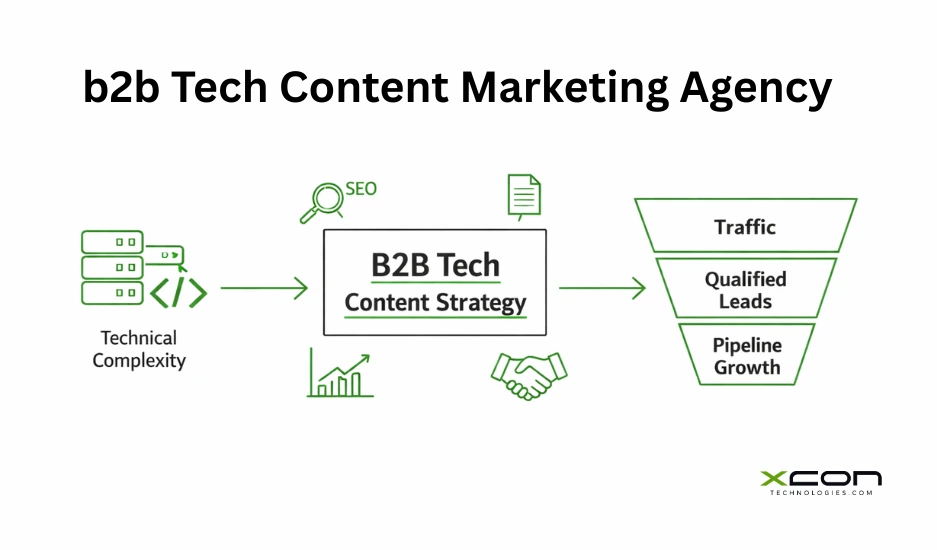
If you’re a B2B CMO at a SaaS, platform, or high-tech company, you already know the truth: good content doesn’t win relevant, consistent, revenue-aligned content wins. The difference between “we publish a lot” and “we drive pipeline” comes down to focus, positioning, and execution.
A specialized B2B tech content marketing agency exists for one reason: to turn technical complexity into business value, build trust across the buyer journey, and generate qualified leads that your sales team can actually convert.
The Essential Role of a B2B Tech Content Marketing Agency
What does a B2B tech content marketing agency do?
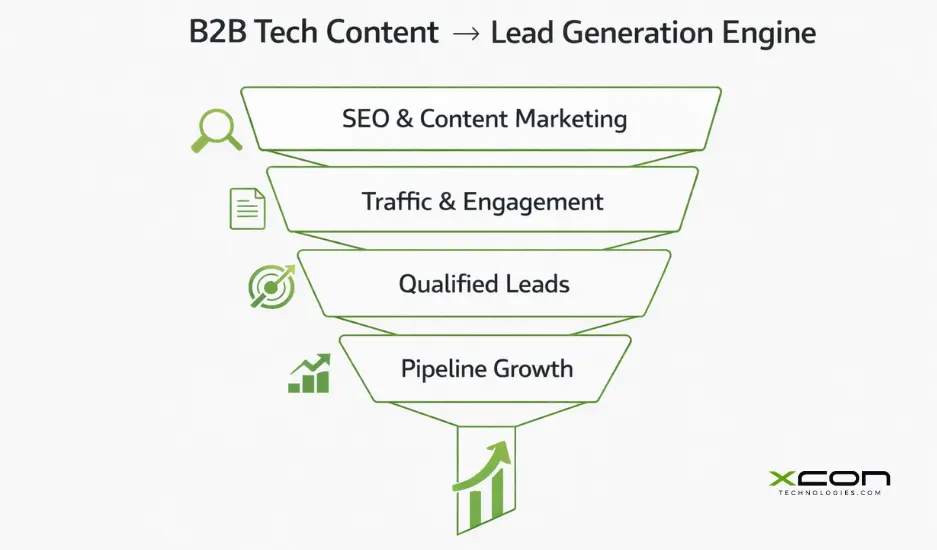
A B2B tech content marketing agency helps tech companies create strategy-led content that attracts the right target audience, builds authority, and drives lead generation. It produces technical content, SEO pages, case studies, and sales enablement assets aligned to the buyer journey so marketing efforts translate into qualified leads and pipeline growth.
Navigating the Complex B2B Tech Landscape
In B2B tech, buyers don’t “browse and buy.” They research, compare, validate, and involve multiple stakeholders in security, finance, IT, RevOps, and the end user. That means content must work across:
- Search (technical SEO + keyword research)
- Education (product features → outcomes)
- Sales conversations (objection handling, proof, ROI)
- Demand generation (nurture, retarget, ABM)
Why Specialization Matters: Beyond Generic Content Marketing
General SEO agencies often write like they’re optimizing for robots. Generic content agencies write like they’re optimizing for vibes. B2B tech needs a third type: the technical translator, someone who can understand your product, map it to business impact, and communicate it to decision makers.
The Core Value Proposition: Driving Growth and Pipeline for Tech Companies
A great partner doesn’t just ship blog posts. They build a system that creates:
- SEO-led inbound growth
- Sales enablement that shortens sales cycles
- Content strategy that supports GTM strategy
- Performance tracking that proves ROI
This is where B2B Tech Content becomes an engine, not an expense.
The Unique Challenges of Content Marketing in B2B Tech
Translating Technical Complexity into Business Value
Your product may be brilliant but buyers still ask, “So what?” Strong content bridges that gap:
Feature → Capability → Use case → Outcome → Proof
Example:
- Feature: “Role-based access control”
- Outcome: “Lower compliance risk + faster audits”
- Proof: “Reduced audit time by 30% (case studies)”
Understanding the Intricate B2B Buyer Journey and Sales Cycles
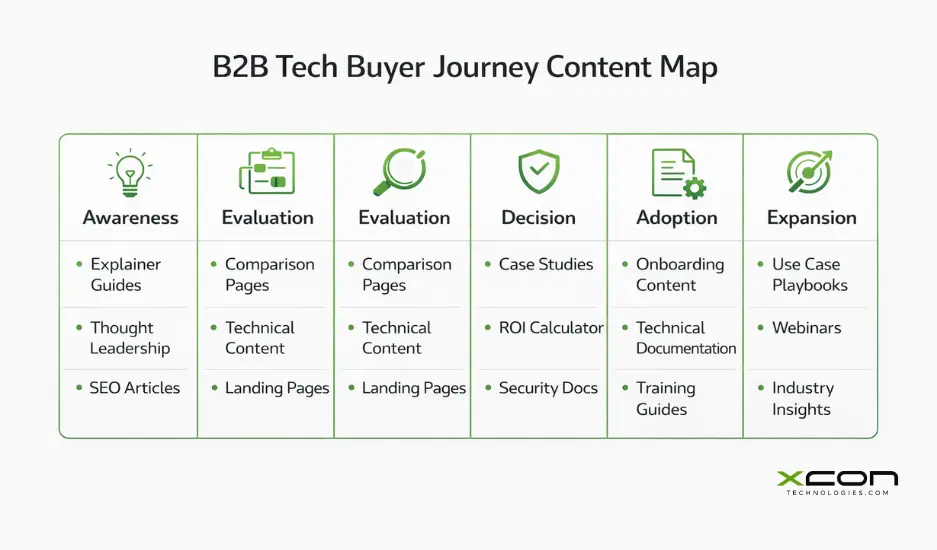
Most B2B SaaS and high-tech companies deal with long sales cycles and complex lead nurturing. Your content should match each stage:
| Buyer Stage | What They Ask | Best Content Types |
| Awareness | “What is this problem?” | Explainers, guides, thought leadership |
| Evaluation | “Which solution is best?” | Comparison pages, landing pages, technical content |
| Decision | “Will it work for us?” | Case studies, security docs, ROI calculators |
| Adoption | “How do we implement it?” | Docs, onboarding, training content |
| Expansion | “Can we scale this?” | Use cases, playbooks, webinars |
Addressing Diverse Decision Makers with Tailored Content
Your “buyer” is rarely one person. A CMO cares about pipeline growth. A security lead cares about risk. A CFO cares about business value. Your content must segment by:
- industry (health tech, HR tech, retail tech)
- role (RevOps, IT, procurement)
- maturity (startup vs enterprise)
The Need for Long-Term Strategy in Fast-Paced Markets
Trends shift fast in the B2B tech landscape. But the winners build content roadmaps based on stable demand:
- Core problems buyers always search
- Category education
- Implementation and integration content
- Proof and differentiation assets
Strategic Pillars of a B2B Tech Content Marketing Agency
Developing a Robust Content Strategy for Tech Companies
A working content strategy is not “write 8 blogs a month.” It’s a plan that connects to revenue:
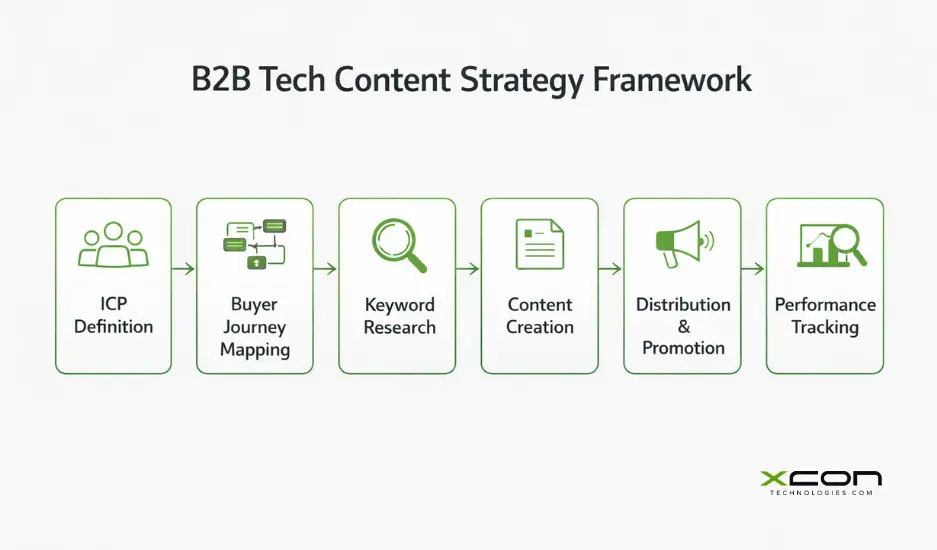
Step-by-step strategy (practical and fast):
- Define ICP + target audience (roles, industries, pains)
- Map buyer journey + sales process questions
- Build a core keyword universe (high-frequency + intent-based)
- Create a content roadmap (clusters + landing pages + proof)
- Align with marketing automation + lead nurturing flows
- Add performance tracking from day one
Expert Technical Content Creation and Production
This is the production layer: content creation that sounds credible to technical buyers and compelling to executives.
High-performing formats:
- Long-form authority content (pillar pages)
- Product-led use case pages
- Technical SEO pages (integration, compatibility, “how to”)
- Case studies (results + implementation detail)
- Website copy and website design collaboration (UX design + CRO)
Driving SEO-Led Inbound Growth
B2B search is full of high-intent queries especially in categories like B2B SaaS, platform-based businesses, and Managed Service Providers (MSSP).
Your agency should build:
- Topic clusters around content marketing and product category terms
- Bottom-funnel pages (comparisons, alternatives, “best” lists)
- Surround Sound SEO: being present beyond your site via partner mentions, podcasts, guest posts, and thought leadership distribution
Fueling Lead Generation and Demand Generation
Content isn’t only for SEO. It’s also fuel for demand generation:
- ABM ads pointing to persona landing pages
- Webinar → recap post → nurture sequence
- Research report → gated lead magnet → sales follow-up
If your goal is qualified leads, the content must be designed to convert not just rank.
Enabling Sales with Powerful Content
Sales enablement is often the fastest ROI. Strong content reduces friction in sales cycles.
Examples:
- Objection-handling one-pagers
- “Why us” battlecards
- Industry-specific solution briefs
- Case studies by segment (health tech, HR tech, retail tech, high-tech companies)
Measuring Success: Data, Metrics, and ROI in Tech Content Marketing
How do you measure B2B tech content ROI?
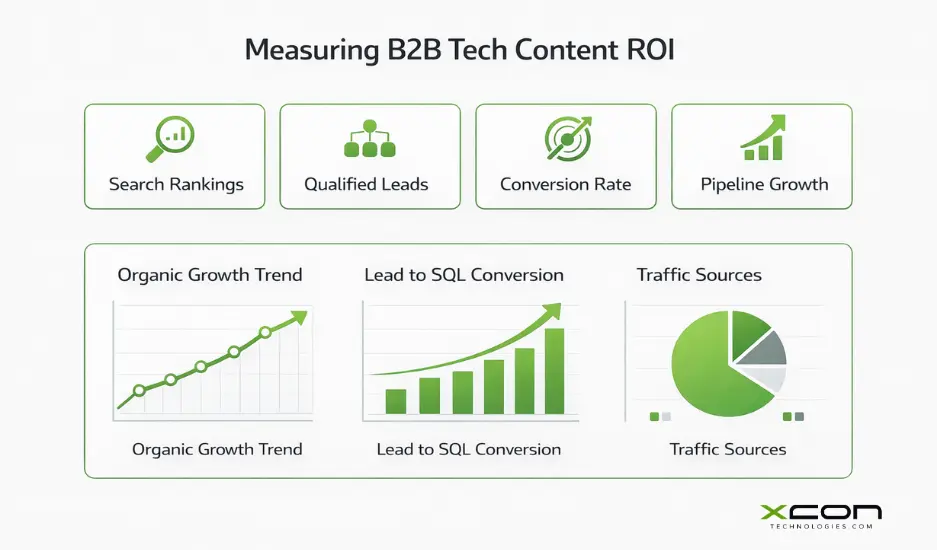
Measure B2B tech content ROI by tracking leading indicators (search rankings, organic clicks, conversion rate optimization) and revenue indicators (qualified leads, influenced pipeline, sales cycle velocity). Use attribution plus cohort analysis to connect content production to pipeline growth over time, not just last-click conversions.
Establishing Key Performance Indicators (KPIs) and Metrics
Track both momentum and money:
SEO KPIs
- search rankings for core keywords
- organic traffic to money pages
- click-through rate and time on page
Pipeline KPIs
- MQL → SQL rate (or PQL if product-led)
- lead-to-opportunity conversion
- influenced pipeline and inbound pipeline
Content quality KPIs
- assisted conversions
- engagement by persona
- content-to-demo conversion rate
Leveraging Data and Analytics for Continuous Optimization
High-performing agencies run monthly cycles:
- refresh winners, prune underperformers
- improve internal linking
- update proof points and product features
- test landing pages (CRO + copy updates)
Understanding Content Economics and Long-Term Value
Content is a compounding asset. A strong pillar page can generate demand for years if maintained especially when paired with content promotion and distribution.
Choosing the Right B2B Tech Content Marketing Agency
Expertise in Specific Tech Niches
Ask: “Have you shipped technical content that technical buyers respect?”
Bonus if they understand marketing platforms, RevOps workflows, and GTM strategy.
A Proven Track Record with Demonstrable Results and Case Studies
You want case studies that show:
- what they changed (strategy + execution)
- what improved (qualified leads, pipeline growth)
- timeframe + constraints
The “Technical Translator” Advantage: Bridging Product and Market Needs
Look for a team that can interview product, sales, and customers and turn that into content that decision makers trust.
Agency Culture: A Strategic Partner, Not Just a Vendor
Signals of a true partner:
- challenges assumptions
- ties content to growth goals
- builds a repeatable content marketing program
- documents processes and improves them
Adaptability and Future-Readiness: Navigating the Evolving Tech Landscape
AI search is changing discovery. Your agency should understand:
- entity-based SEO
- content engineering
- structured content for AI answers
- distribution beyond Google
The Future of B2B Tech Content Marketing Agencies
The Impact of AI and Content Automation
AI helps scale drafts and repurposing but strategy, positioning, and proof still win. Expect more “human-in-the-loop” workflows: faster production, higher editorial standards.
Evolving Approaches to Content Engineering and Scaled Production
Winning teams build systems:
- modular content blocks
- reusable proof libraries
- consistent messaging frameworks
- update cycles tied to product releases
Hyper-Personalization and the Role of Advanced ABM Strategies
ABM content will become more targeted:
- persona pages
- industry playbooks
- role-based landing pages
- segmented email sequences for lead nurturing
The Blurring Lines: Content as a Core Business Asset
Content won’t sit “in marketing” anymore. It will support:
- sales process
- onboarding
- customer generation and retention
- product launches and partner ecosystems
Conclusion:
Recap of the Value a Specialized Agency Brings
A specialized agency gives you the strategy + production power to turn B2B Tech Content into a pipeline.
The Imperative for a Data-Driven, Strategic Approach
Content must be measured like performance marketing without losing credibility and depth.
Partnering for Sustainable Pipeline Growth and Market Leadership
If you want consistent qualified leads, shorter sales cycles, and stronger category authority, treat content like an operating system not a campaign.
Pros/Cons: Hiring a B2B Tech Content Agency
Pros
- Faster content production without hiring overhead
- Better alignment to buyer journey + ABM
- Stronger SEO-led inbound growth
- More case studies and sales enablement output
Cons
- Needs strong onboarding (product, ICP, positioning)
- Results compound expect 60–120 days for meaningful SEO movement
- Weak agencies can produce “fluffy” content that doesn’t convert
Use Cases
- Building “money pages” + landing pages for demand generation
- Creating segmented case studies for different industries
- Launching a content roadmap for core keywords
- Sales enablement packs to support sales cycles
- Website redesign + UX design + website copy to lift conversion rate optimization
FAQs
Most teams see early traction in 30–60 days from sales enablement and landing pages. SEO-led inbound growth typically becomes noticeable in 3–6 months, depending on competition, domain authority, and content quality.
High-intent assets: comparison pages, “best for” pages, integration pages, ROI content, and case studies. These match decision-stage intent and usually outperform generic blog posts for lead generation.
Use a hybrid approach. Keep core educational content ungated for SEO and trust, and gate high-value assets (benchmarks, templates, playbooks) to support demand generation and lead nurturing.
Quality beats volume, but consistency matters. Many tech companies do well with 4–8 high-quality pieces monthly plus 1–2 conversion assets (landing pages, case studies, sales enablement).
SEO agencies often focus on rankings and technical SEO. A B2B tech content marketing agency should cover content strategy, technical content, positioning, distribution, conversion, and sales enablement so marketing efforts translate into pipeline growth.