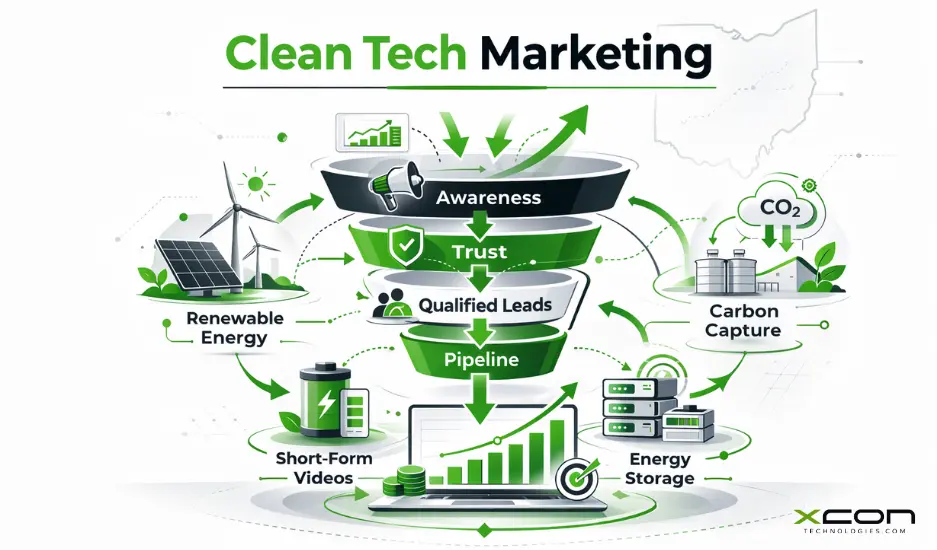
Is your clean tech product brilliant but still hard to sell? Clean Tech Marketing helps you build trust and get qualified inquiries. We do this through proof-led messaging, intent-based digital marketing, and credibility-first ESG communication.
You’re not only up against other climate-focused companies. You’re also facing doubt, long sales cycles, and “too-good-to-be-true” claims. What if your next prospect understood your value in 30 seconds and wanted the next call?
Short Summary
Fully focused on marketing systems for renewable energy, climate tech, and sustainable brands. Perfect fit for a clean tech brand. Perfect for a climate tech marketing agency. Also great for a sustainability communications agency website. Show technical solutions. Use solar panels, energy storage, and carbon capture. Make it clear and credible. You’ll boost lead generation. You’ll also simplify sales funnels. And you’ll do it all without greenwashing.
Why does Clean Tech Marketing matter?
Clean Tech Marketing is important. Buyers deal with risk, complexity, and skepticism. They need clarity, evidence, and reassurance before making a commitment. A good strategy connects product marketing, brand storytelling, and search engine optimization. This helps educate decision-makers. It builds trust and creates a solid pipeline. This is especially true for procurement and tender requests.
The green economy has unique demands.
Even if your solution is better than fossil fuels, the buying process can be tricky. Common “hidden blockers” include:
- internal committees and Buyer Personas you can’t see yet
- Technology Adoption Hurdles (integration, training, compliance)
- Measurement and Reporting Gaps (unclear baselines, unclear results)
- “Brand visibility” problems: great tech, weak explanations.
“General marketing” often fails here.
In the advertising world, generic campaigns can bring clicks but not confidence. Clean tech buyers usually have a desire for:
- proof from project case studies
- clear visuals and messaging for non-technical stakeholders
- credibility signals (standards, certifications, reputable partners)
How do you win buyers’ trust?
You earn trust by making your claims clear and easy to verify. Be specific, and repeat these claims across your website, content, and sales points. If you’re in Ohio, trust is local. Buyers seek dependable partners. They need clear service coverage and proof of your success in their market.
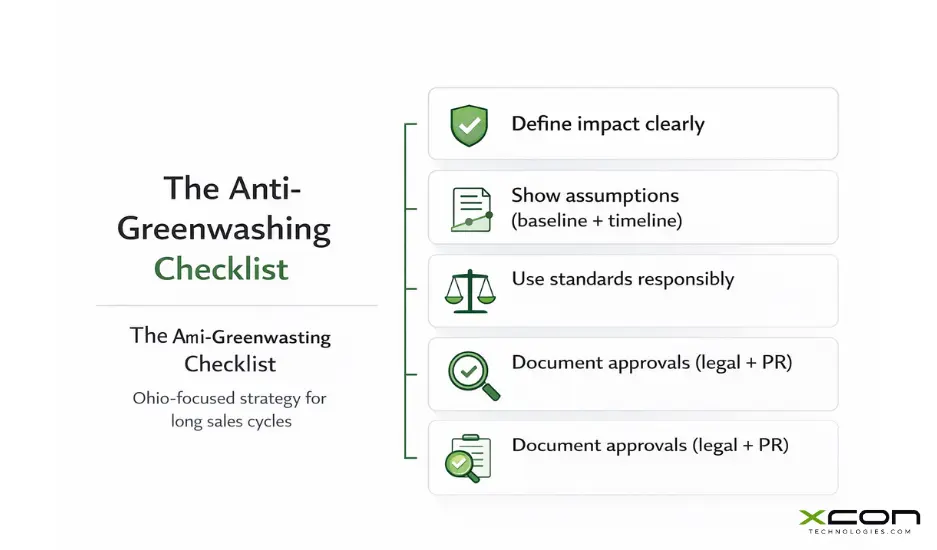
The anti-greenwashing checklist
Use this playbook to protect reputation and resilience:
- Define impact clearly: what you reduce (carbon pollution), how, and by how much.
- Show assumptions: baselines, timelines, and what is excluded.
- Use third-party language carefully; cite frameworks without exaggeration.
- Document approvals: align with legal and PR professionals to avoid legal threats.
Credibility references to mention
You can reference recognized practices and tools, like:
- GHG Protocol (emissions accounting approach)
- ISO standards where relevant (quality, environmental management)
- Google Business Profile for local proof and legitimacy.
- CRM systems (HubSpot, Salesforce) for sales and marketing alignment.
- analytics standards (consistent UTM structure, conversion tracking hygiene)
Core pillars for clean growth
A high-performing go-to-market plan usually rests on a few pillars that work together. Think “Strategic Marketing & Communications,” not random tactics.
The services that move pipelines.
- Strategic Branding: positioning, messaging, category clarity
- Content marketing: explainers, comparison pages, use case pages
- Digital marketing: intent-based search, retargeting, landing pages
- PPC strategy: segment by problem and industry, not keywords
- Public relations: credibility, thought leadership, and third-party validation
- Campaign development: aligned assets for each stage of the journey.
Where should your content focus first
Rank what removes doubt the fastest:
- “How it works” pages (simple, visual, jargon-free)
- ROI & Visibility pages (cost, payback, reliability outcomes)
- industry pages (smart cities, energy-efficient manufacturers, industrial processing equipment)
- product pages that connect features to outcomes (remote monitoring solutions, predictive analytics)
What shortens long sales cycles?
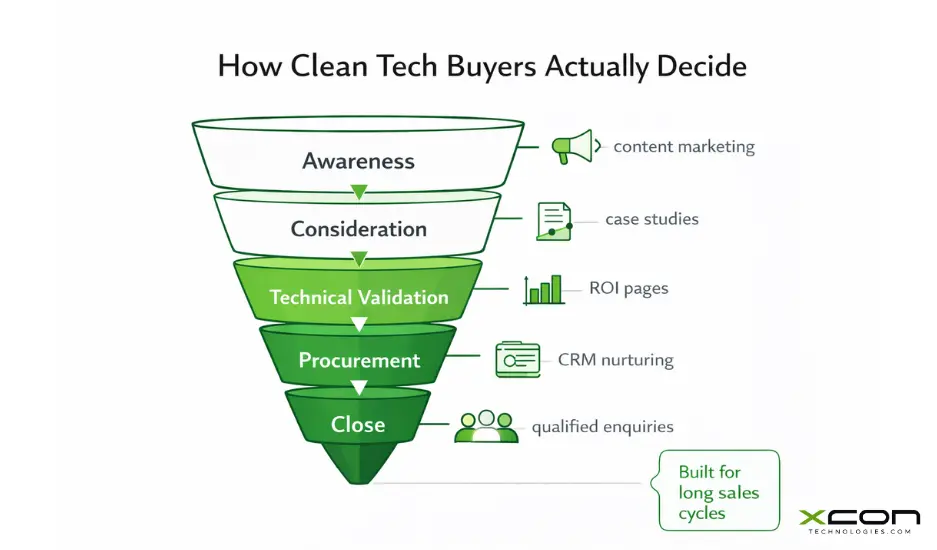
Shorten sales cycles by answering technical and financial questions early. Then, nurture stakeholders with proof that matches their stage. A funnel designed for multi-step decision-making helps reduce Sales & Marketing disconnect. It also improves lead quality and conversion. Plus, it prevents brand message misalignment between ads and sales decks.
Steps to shorten long cycles (How To)
- Map the buying committee: technical, finance, operations, and procurement.
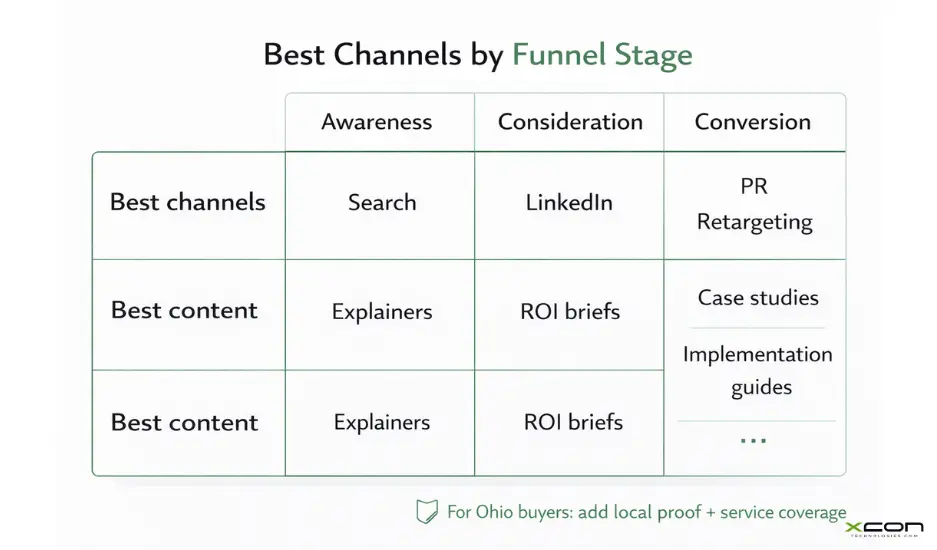
- Build one proof asset per stage: explainer → ROI brief → case study → implementation guide.
- Qualify early: forms that capture the use case, timeline, and constraints.
- Automate nurturing: email + retargeting + sales enablement via your CRM.
- Reduce friction: clear demo flow, pricing logic, and implementation expectations.
What a “good” funnel feels like
- fewer leads, higher close rates
- Fewer “video call” no-shows occur because we pre-qualify intent.
- faster approvals because stakeholders have shareable assets
Measuring ROI and real impact.
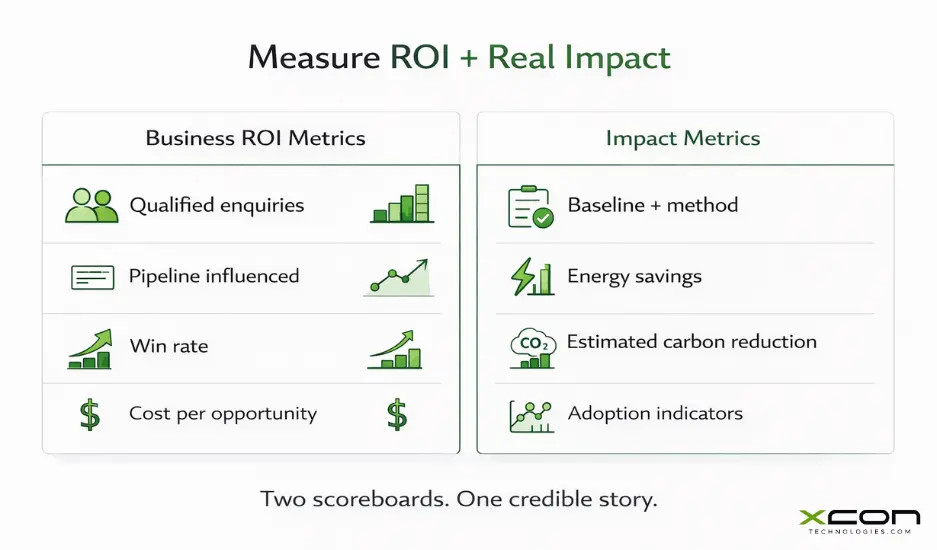
You need two scoreboards: business performance and sustainability outcomes. The best teams link lead generation metrics to revenue. They also tie sustainability marketing claims to clear carbon-reduction results.
Metrics that matter (business)
- qualified inquiries per channel (search vs. social media vs. PR)
- sales cycle length by segment (EV infrastructure vs. heat pumps, etc.)
- pipeline influence and win rate
- cost per opportunity (not cost per lead)
Metrics that matter (impact)
- baseline + method (what changed, how measured)
- energy savings, uptime, or efficiency improvements
- estimated emissions reduction assumptions (clearly stated)
- adoption indicators (installations, retention, expansion)
Steps to fix reporting gaps (How To)
- Set a single source of truth: CRM, analytics, and agreed definitions.
- Standardize tracking: UTMs, conversion events, lifecycle stages.
- Publish proof consistently: update case studies and outcomes quarterly.
- Review monthly: identify drop-offs in complicated sales funnels and adjust.
Pro Tips / Common Mistakes
- Don’t sell “a sustainable future” as a slogan to promote specific outcomes and trade-offs.
- Avoid copying competitors’ claims; it increases skepticism and weakens differentiation.
- If your results depend on site conditions, say it plainly; trust rises when you’re honest.
- For Ohio businesses, add local proof. Clarify your service area. Share your response times. Provide real project references.
- When you pitch “AI-driven hyper-personalization,” stay human and factual. Don’t make big promises.
Final Thoughts
Clean tech buyers don’t want innovation; they want certainty. When your message is clear and your proof is solid, you build trust. If your funnel considers long decision cycles, you become a safe choice. Plus, you won’t sound boring.
Build one strong case study, one ROI page, and one intent-based campaign. That trio usually beats a dozen generic posts.
FAQs
Use proof-driven messaging, share case studies, and run intent-based ads. Also, engage stakeholders with technical content and follow up through CRM.
Yes buyers research heavily. Publish ROI pages, explainer videos, and impact reports. This will reduce confusion and boost lead quality.
Avoid vague “eco” claims. Use clear baselines, note standards, and share assumptions to keep your story credible.
Start with high-intent search and LinkedIn, then retarget with case studies. Add PR once claims and proof points are stable.
Ask for clean-energy case studies, measurement setup, and a greenwashing checklist. If they can’t explain your tech, pass.