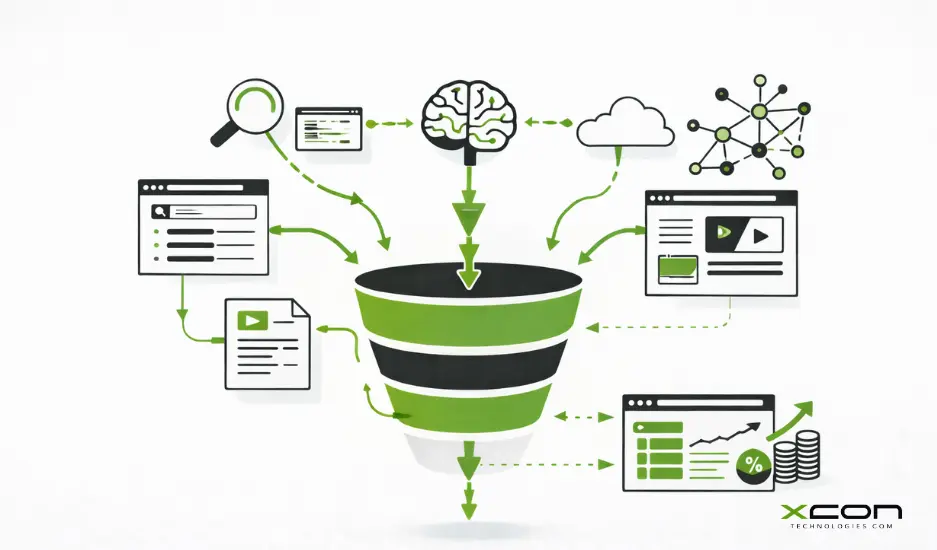
Tech content marketing means creating expert resources. These resources turn complex B2B solutions into valuable assets. They help attract high-intent leads. In an AI-first search world, this method helps your brand reach decision-makers. It does so by answering their specific technical questions right away.
The modern B2B buyer journey has evolved significantly. Decision-makers use AI search tools and do their own research first. They often talk to a sales rep only after that. To stay competitive, shift your strategy. Focus on precision targeting instead of general awareness. Use content marketing to connect directly with CTOs and CIOs. Are you ready to adapt your approach for the 2026 algorithm?
Quick Summary
Tech content marketing links complex B2B solutions to serious buyers. It does this with expert resources. Tech companies can lead search results with AI insights, semantic SEO, and multi-channel distribution. This strategy builds trust, shortens sales cycles, and drives qualified lead generation.
Why Does Tech Content Marketing Drive High-Intent Leads?

Tech content marketing attracts serious buyers. It reduces risk in lengthy, costly B2B sales cycles. Picking the wrong enterprise software or hardware can cost a company a lot. It can lead to millions in losses.
Content serves as the primary trust signal. Offering clear technical insights instead of fluff makes your brand a trusted expert. This influence affects everyone in the buying committee. It starts with the procurement officer checking compliance and includes the developer testing APIs.
- Reduces Perceived Risk: Expert content proves that your solution works.
- Educates the Buyer: Informed prospects move through the funnel more quickly.
- Builds Brand Authority: establishes you as the industry leader.
- Supports Sales Teams: Provides assets that address specific objections.
How do you target qualified leads in tech?
To target qualified leads in tech, go beyond basic demographics. Focus on the specific “jobs to be done” for your ideal customer profile (ICP). You must map your content to the specific pain points of the people signing the contracts.
This involves distinct steps to ensure your message lands:
- Define the Buyer Committee:
- Identify the roles involved:
- CTO for technical fit.
- CFO for financial viability.
- End users for usability.
- Identify the roles involved:
- Map Search Intent: Align your content with where they are in the funnel. Are they looking for “What is cloud migration?” (Awareness) or “AWS vs. Azure pricing” (Decision)?
What is a data-driven content strategy?

A data-driven strategy relies on analytics, intent data, and AI insights. This approach takes the guesswork out of marketing strategies. Instead of hoping a topic resonates, you use data to predict what your audience needs to read before they buy.
To succeed in SEO for 2026, focus on topical authority instead of just keywords. This means creating clusters of content that cover a subject exhaustively.
- Keyword Clusters: Grouping related terms to own a topic niche.
- Intent Data: Using tools to see which accounts are actively researching your solution.
- Semantic SEO: Writing for topics and entities, not just strings of text.
- Competitive Gap Analysis: Finding what your competitors missed.
How can you build content authority?
You build content authority by prioritizing E-E-A-T (Experience, Expertise, Authoritativeness, and Trustworthiness). In B2B tech marketing, fluff is fatal. Your audience is made up of engineers and experts. They will notice any lack of depth right away.
Talk to your internal SMEs (Subject Matter Experts) to simplify complex technology. This way, you can keep it accurate. A generic copywriter cannot explain edge computing nuances like your lead engineer can.
- Showcase Credentials: Highlight the bio and experience of the author.
- Cite Original Data: Use your own internal research or case studies.
- Balance Depth and Clarity: Make complex ideas accessible but not dumbed down.
- Provide Proof: Use screenshots, code snippets, or architecture diagrams.
Where should you distribute tech content?
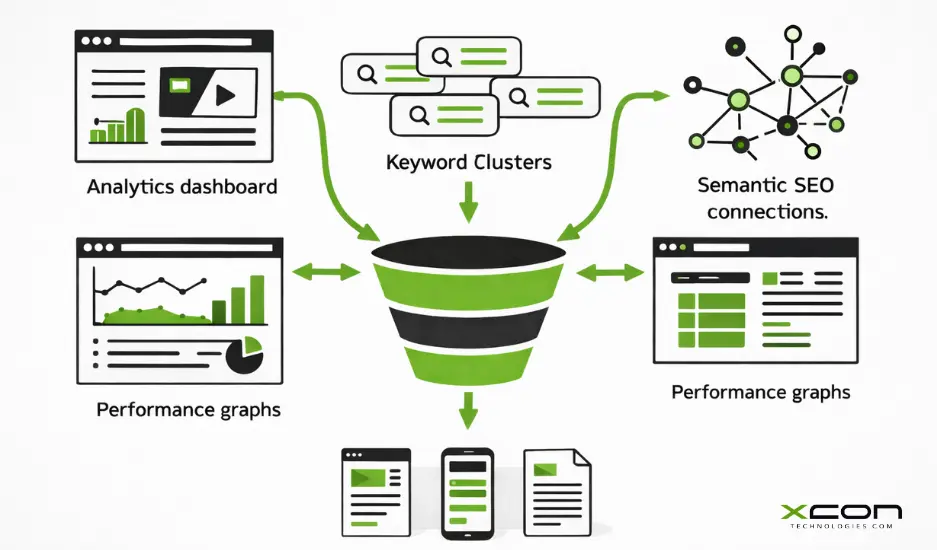
Distribute your content across owned, earned, and paid media. This mix helps ensure greatest visibility. Publishing a blog post isn’t enough. Share your content where your audience hangs out. It doesn’t matter if you’re in San Francisco or London.
An effective amplification strategy includes:
- Organic Search: Optimizing for Google and AI Answer Engines.
- Social Media: Breaking down white papers into LinkedIn carousel posts.
- Content syndication: Republishing on platforms like Medium or industry journals.
- Email Marketing: Nurturing existing leads with targeted newsletters.
How do you optimize for AI search engines?
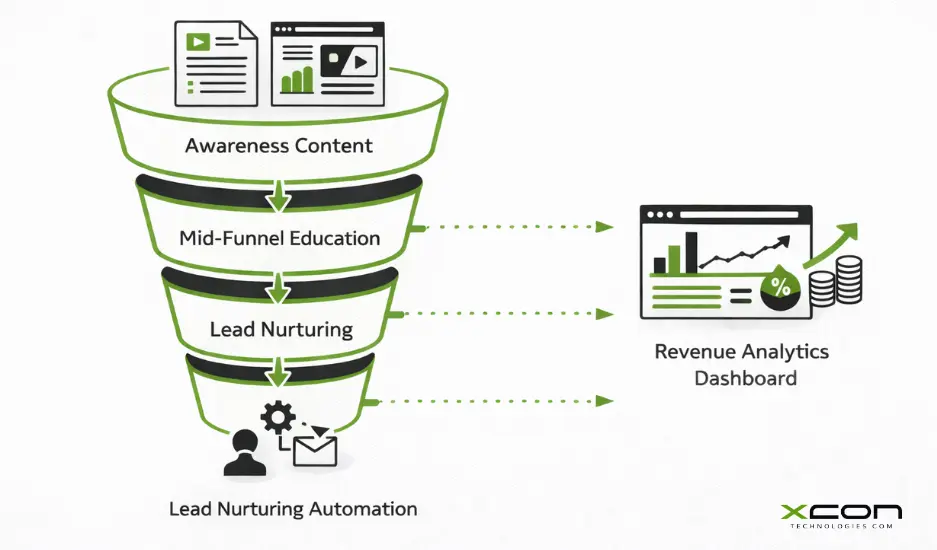
To optimize for AI search engines (AEO) and Generative Engine Optimization (GEO), structure your content so machines can read it easily. AI tools like ChatGPT and Google’s AI Overviews prioritize direct, factual answers.
To win “zero-click” visibility, your content needs to answer questions immediately. Use clear headings and structured data. This helps large language models (LLMs) cite your brand as the source of truth.
- Answer First: Provide the “what is” answer in the first 50 words.
- Use schema markup: Help search engines understand your content type.
- Target Long-Tail Queries: Answer specific, conversational questions.
- Optimize for Brand Mentions: Ensure your brand appears in “best of” lists.
How do you measure content ROI?
You measure content ROI by connecting content consumption to revenue and pipeline generation. Vanity metrics like page views are useful, but they do not pay the bills. You need to track how content influences lead generation.
Use attribution models to see the full picture:
- First-Touch Attribution: Which content brought them to the site?
- Multi-Touch Attribution: Which assets did they engage with before buying?
- Pipeline Velocity: Does content help deals close faster?
- CAC (Customer Acquisition Cost): Is organic content lowering your costs per lead?
Pro Tips for 2026
- Update Old Content: Refresh your top posts every 6 months to keep data current.
- Leverage Video: Embed video summaries in your blogs to capture different learning styles.
- Focus on Retention: Create content for current customers. This helps reduce churn and keeps them engaged, not just attracting new leads.
- Use AI Wisely: Use AI for outlines and research, but ensure a human SME writes the final draft.
Final Thoughts
Dominating the tech content marketing landscape in 2026 requires more than just keywords. It requires a commitment to quality and a strong grasp of technical details. You also need to understand the AI-driven buyer journey. Build a scalable content machine now. This way, you secure a steady stream of qualified leads for the future.
FAQ
Tech content marketing creates educational materials. These help B2B buyers understand and buy complex tech solutions. It builds trust and authority with decision-makers.
Content attracts users searching for solutions to specific problems. Offering valuable insights, like a whitepaper download, helps turn anonymous visitors into leads. In return for their contact information, you gain actionable prospects.
The tech industry benefits most from these formats:
In-depth technical blogs
Case studies
Whitepapers
Comparison guides
Video tutorials
These formats allow for the necessary depth to explain complex solutions.
Generally, SEO takes 6 to 12 months to show significant results. However, with a focused strategy on low-competition, high-intent keywords, you can see initial traction in 3 to 4 months.
E-E-A-T is critical because tech decisions often involve high financial risk. Google prioritizes content from trusted experts. This helps users find accurate and safe advice. It also directly affects your search rankings.