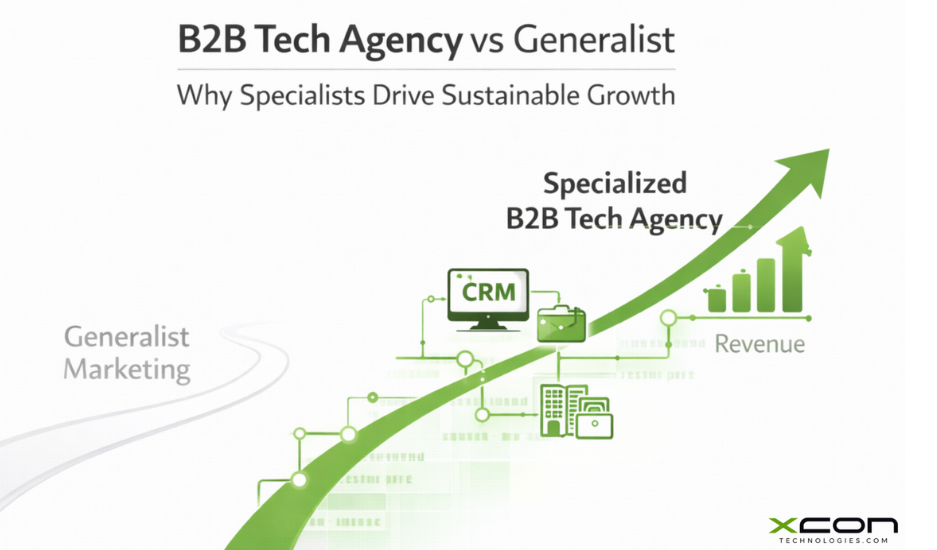
Partnering with a specialized B2B tech agency is the most effective way to navigate complex sales cycles and technical value propositions. While generalist agencies often struggle with the nuances of SaaS and enterprise software, a dedicated tech partner aligns your marketing strategy directly with revenue goals.
Are you tired of explaining your own product to the people hired to market it? In the fast-moving tech world, speed and accuracy are everything. A specialized agency brings day-one expertise, allowing you to bypass the learning curve and focus immediately on generating high-quality leads and closing deals.
Short Summary
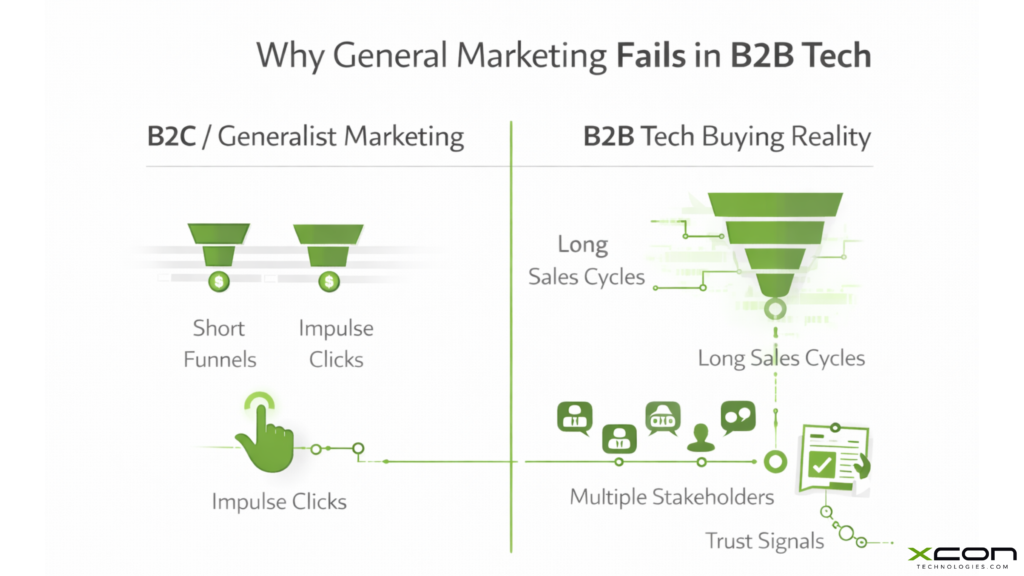
- Deep Industry Knowledge: No time wasted explaining “cloud-native” or “API integration.”
- Strategic Alignment: Marketing that maps perfectly to complex buyer journeys and sales cycles.
- Better ROI: Data-driven strategies that prioritize pipeline quality over vanity metrics.
- Full-Funnel Expertise: From brand awareness to sales enablement and retention.
The B2B Tech Reality General Agencies Miss
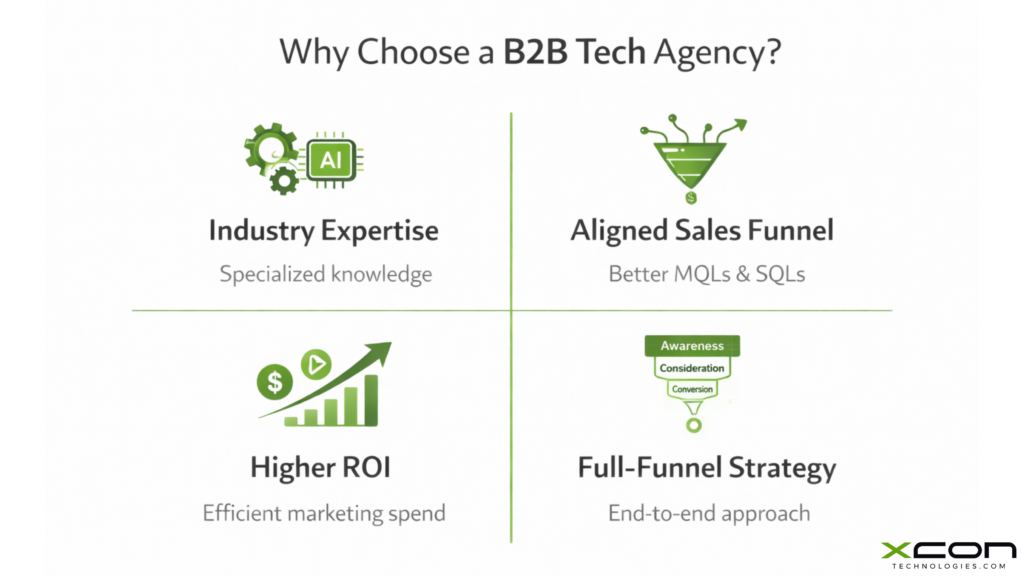
Most general marketing agencies operate on a “volume-first” mindset that works well for B2C but fails miserably in B2B tech. They focus on impressions and clicks, missing the critical context of enterprise buying behavior.
In the tech sector, specifically hubs like those growing in Ohio, a generic approach creates a disconnect. Your buyers aren’t impulse shoppers; they are sophisticated decision-makers evaluating long-term investments. A specialized B2B tech agency understands that you aren’t just selling a product, you’re selling a solution to a complex business problem.
How do complex sales cycles affect marketing?
B2B tech sales cycles are long, often lasting 6 to 18 months, requiring sustained engagement strategies rather than quick-hit campaigns. A generalist agency often abandons leads that don’t convert immediately, whereas a specialized partner builds nurturing infrastructure.
- Buying Committees: Decisions involve 6-10 stakeholders, from IT directors to CFOs.
- Consensus Building: Marketing must arm your champions with data to convince skeptics.
- Risk Aversion: Buyers are terrified of implementation failure, so trust signals are paramount.
- Touchpoints: It takes dozens of interactions across various channels to move a prospect forward.
What is the challenge of communicating complex tech value?
The biggest hurdle in B2B tech is translating dense technical specifications into compelling business value without dumbing it down. Generalists often resort to buzzwords because they don’t grasp the underlying technology.
A specialized agency knows how to turn “AI-driven predictive analytics” into “reduce operational downtime by 30%.” They bridge the gap between product management and the C-suite, ensuring your messaging resonates with the person signing the check, not just the person using the tool.
How can you stand out in a saturated market?
DIFFERENTIATION IS SURVIVAL. In a crowded landscape of SaaS providers and tech products, sounding like everyone else is a death sentence.
- Credibility: You need deep, expert-level content to prove you understand the problem better than competitors.
- Positioning: specialized agencies help you carve out a niche rather than battling for the generic center.
- Trust: High-quality case studies and white papers build the authority needed to win enterprise contracts.
How a Specialized B2B Tech Agency Creates Impact
Specialization isn’t just a buzzword; it’s a performance advantage. An agency that lives and breathes tech can deploy strategies that are pre-validated for your industry.
Instead of guessing what works, they apply proven frameworks. This means faster time-to-market for your campaigns and a quicker path to revenue. They don’t just execute tasks; they act as strategic consultants who understand the competitive landscape of the B2B tech industry.
Why is a data-driven B2B tech strategy essential?
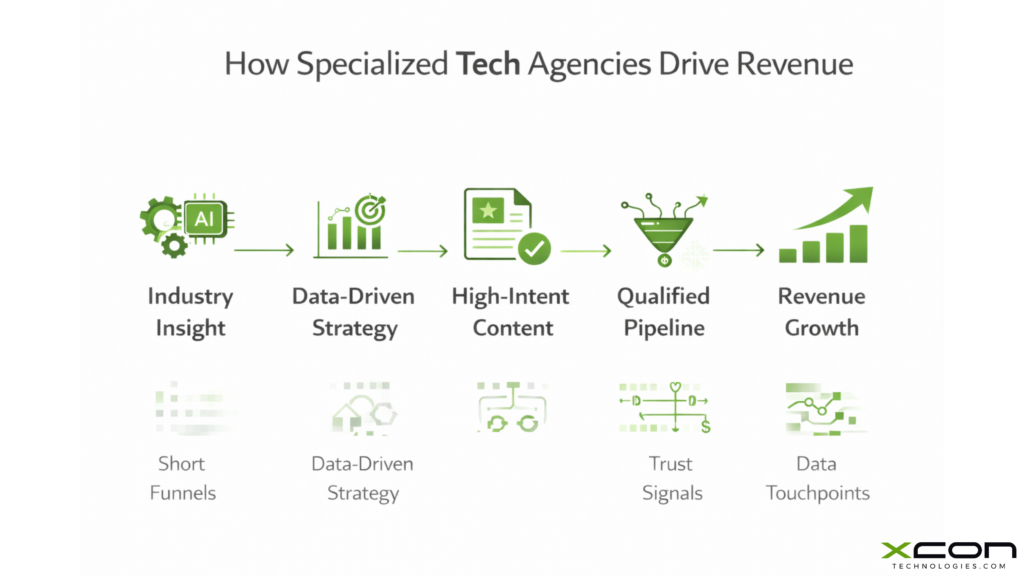
Effective strategy relies on industry-specific insights and precision targeting, not broad demographics. A B2B tech agency uses intent data to identify accounts that are actively researching solutions like yours.
- Target Account Lists (TAL): Focusing budget only on companies that fit your Ideal Customer Profile (ICP).
- Intent Monitoring: Catching buyers when they are in the research phase, before they contact sales.
- Persona Mapping: tailoring messages specifically for the CTO versus the VP of Sales.
What is full-funnel digital expertise?
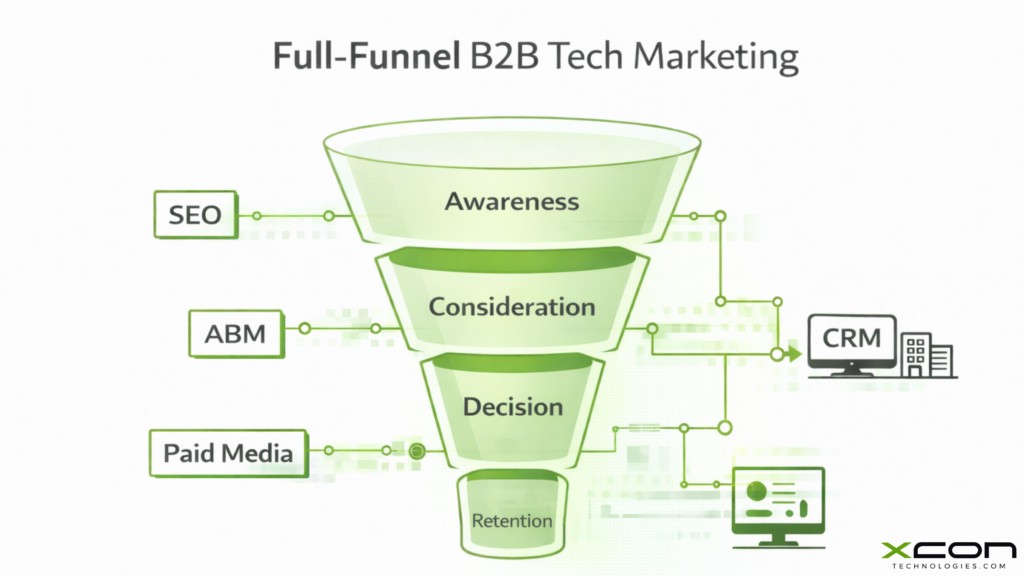
True impact comes from connecting the dots between SEO, paid media, and marketing automation. A siloed approach leaves revenue on the table.
- SEO: Targeting high-intent technical keywords that generalists miss.
- Paid Media: Using LinkedIn ads to target specific job titles and industries with laser precision.
- ABM Alignment: Coordinating marketing air cover with direct sales outreach for high-value targets.
- Retention: creating customer marketing campaigns to drive upsells and reduce churn.
How do high-intent content journeys work?
Content must be mapped to specific stages of the buyer journey, moving prospects from “problem aware” to “solution ready.”
A specialized agency doesn’t just write blog posts; they build content ecosystems. This might look like a top-of-funnel trend report to capture attention, followed by a mid-funnel comparison guide, and finally, a bottom-of-funnel ROI calculator to assist the final decision.
Core Services That Drive Measurable Growth
You need outcomes, not just deliverables. The best agencies focus on metrics that matter to your board: pipeline velocity, customer acquisition cost (CAC), and lifetime value (LTV).
How do you improve demand generation and lead nurturing?
It’s about pipeline quality, ensuring that the leads passed to sales are actually ready to buy. This requires sophisticated lead scoring models that generalists rarely implement effectively.
- Lead Scoring: assigning points based on behavior (e.g., visiting the pricing page).
- Nurture Sequences: Automated email flows that educate prospects over time.
- Sales Enablement: Providing sales teams with the collateral they need to close deals.
Why are analytics, attribution, and optimization critical?
In B2B tech, attribution is messy. A specialized partner helps you track performance across long cycles to understand what’s really driving revenue.
They implement closed-loop reporting to see which marketing activities result in signed contracts. This allows for continuous optimization, shifting budget away from underperforming channels and doubling down on what generates real ROI.
How does brand authority build market trust?
In tech, a brand isn’t just about a pretty logo; it’s a risk reduction mechanism. Strong branding signals stability and innovation.
- Thought Leadership: Positioning your executives as industry visionaries.
- Consistency: Ensuring a unified voice across all technical documentation and marketing channels.
- Reputation Management: actively soliciting and showcasing client success stories.
From Vendor to Strategic Growth Partner
The goal is to shift the relationship from a transactional service provider to a strategic extension of your team.
How does an agency strengthen in-house marketing teams?
Agencies fill skill gaps, allowing your in-house team to focus on their core competencies. You might have a great product marketer but lack expertise in technical SEO or programmatic advertising. The agency plugs these holes, providing specialized talent without the overhead of full-time hires.
Why is compliance-ready and ethical marketing important?
Tech companies often face strict regulatory environments (like GDPR or HIPAA). A specialized agency understands these constraints and ensures all campaigns are compliant, reducing legal risk while maintaining aggressive growth targets.
How do you adapt to rapid tech market shifts?
The tech landscape changes daily. A specialized partner keeps you agile, helping you pivot messaging quickly in response to new competitor features or market disruptions like the rise of AI.
Pro Tips for Choosing the Right Partner
- Check Their Stack: Ensure they use modern tools like HubSpot, Salesforce, or 6sense.
- Ask for Case Studies: Look for examples of companies with similar deal sizes and complexity to yours.
- Meet the Team: Ensure the people pitching you are the ones who will actually work on your account.
- Test Their Knowledge: Ask them to explain a complex concept in your industry during the pitch.
Final Thoughts: The Cost of Inaction
In the competitive world of B2B tech, good enough is no longer enough. Sticking with a generalist agency or trying to do it all in-house can lead to stagnation. Partnering with a specialized B2B tech agency unlocks the expertise, speed, and strategic depth needed to dominate your category. Don’t let your innovative product fail because of outdated marketing.
FAQ
A B2B tech agency understands technical products, long sales cycles, and complex buyer committees. They don’t need to be taught your industry; they bring specialized knowledge that accelerates strategy and execution.
Costs vary, but typically specialized agencies charge a premium for their expertise. However, the ROI is usually significantly higher because they waste less budget on ineffective tactics and generate better-qualified leads.
Yes, ABM is a core competency of most B2B tech agencies. They have the tools and experience to orchestrate personalized campaigns targeting your highest-value accounts.
Absolutely. Agencies complement in-house teams by providing specialized skills (like paid search or technical SEO) and extra capacity, allowing your team to scale efforts without burnout.
While some tactics like paid ads can show immediate results, sustainable growth in B2B tech typically takes 3-6 months of consistent effort to build momentum and mature the pipeline.